Wolfram Asks What AI Means for Pure Math Research
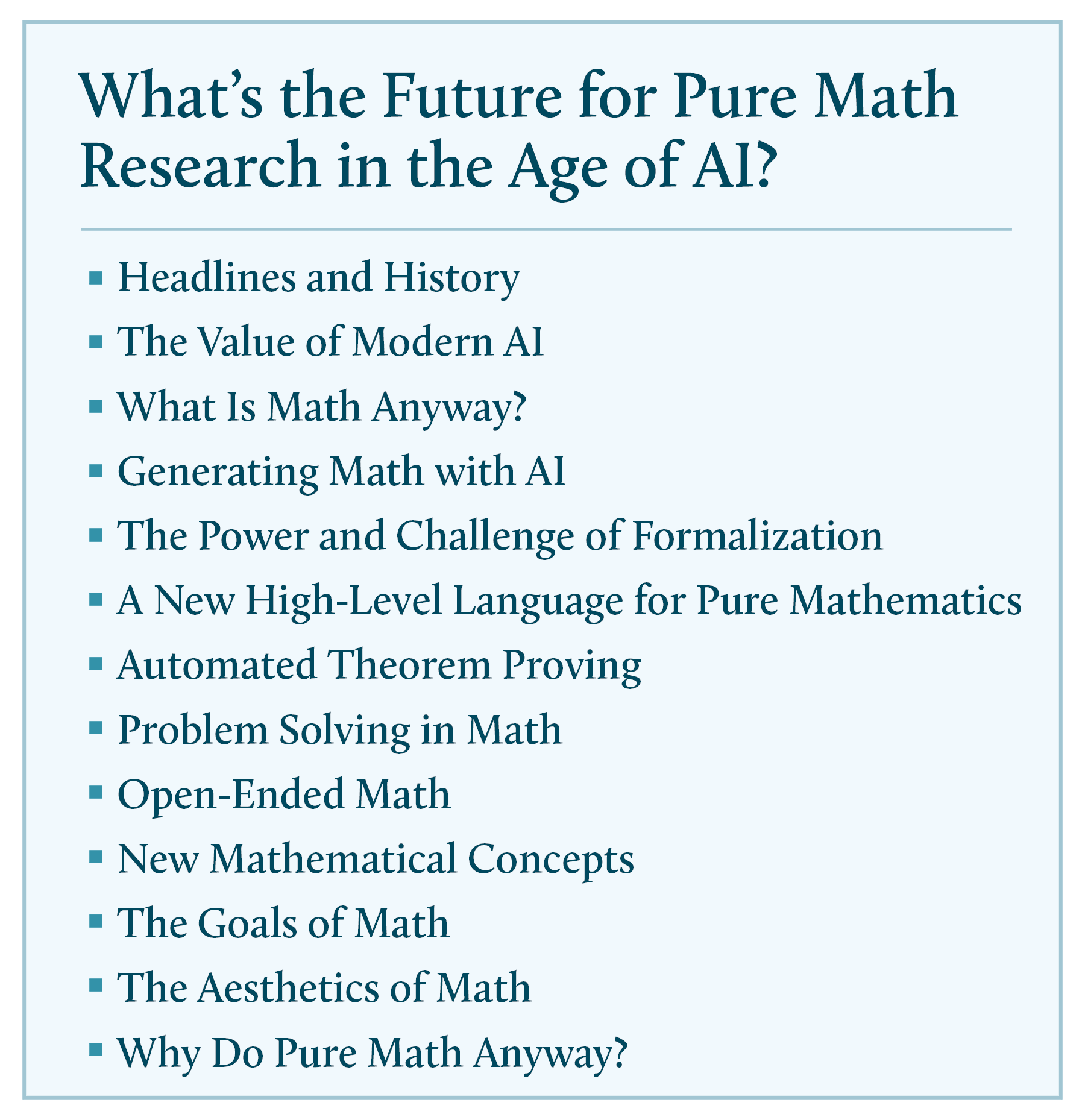
Stephen Wolfram's new essay examines whether AI can contribute to pure mathematics, where choosing which conjecture to attack still resists automation.
Stephen Wolfram published a new essay asking how artificial intelligence will change pure mathematics research, posting it to his personal writings site under the title "What's the Future for Pure Math Research in the Age of AI?" The question carries weight because pure math has long been treated as the discipline least likely to bend to automation, and Wolfram is one of the few people with footing in both computational tooling and foundational mathematics.
His track record explains why the essay gets read. Wolfram built Mathematica, founded Wolfram Research, and spent years developing the Wolfram Language as a system for symbolic and numerical computation. He also advanced the argument that simple programs can generate complex behavior, a thesis he has pushed through his physics project. That combination positions him to speak to where machine reasoning might genuinely help mathematicians rather than just produce plausible-sounding text.
The essay arrives during a broader push to apply AI to formal mathematics. Proof assistants like Lean and Coq let researchers write arguments a computer verifies line by line, and AI groups have paired language models with those tools to propose and check proof steps automatically. In 2024, Google DeepMind's AlphaProof and AlphaGeometry systems reached silver-medal performance on International Mathematical Olympiad problems, a result that put automated reasoning on the map for working mathematicians.
Pure math research is not contest problem-solving, though. Verifying a proof of a known theorem is a narrow target; choosing which conjecture to attack, spotting the right abstraction, and building a theory that later proves useful are activities that resist clean benchmarks. Mathematicians have also raised concerns about AI producing arguments that look correct while hiding subtle gaps, which is why formal verification is becoming a more common companion to model-generated work.
Wolfram's essay adds a practitioner's voice to a debate that has mostly been driven by AI labs and academic computer scientists. The part readers are likely to argue over is his view on whether machines will serve as assistants, collaborators, or something closer to competitors. The larger open question is whether AI changes the daily work of mathematicians or mostly expands the set of problems they can attempt, and the answer will come from how the field's tools and incentives shift over the next few years rather than from any single essay.