Graph RAG vs Plain RAG vs Long Context: A Laptop Benchmark Puts All Three to the Test
A hands-on comparison of four retrieval architectures on identical documents and questions finds graph RAG's advantage is narrower than the hype suggests.
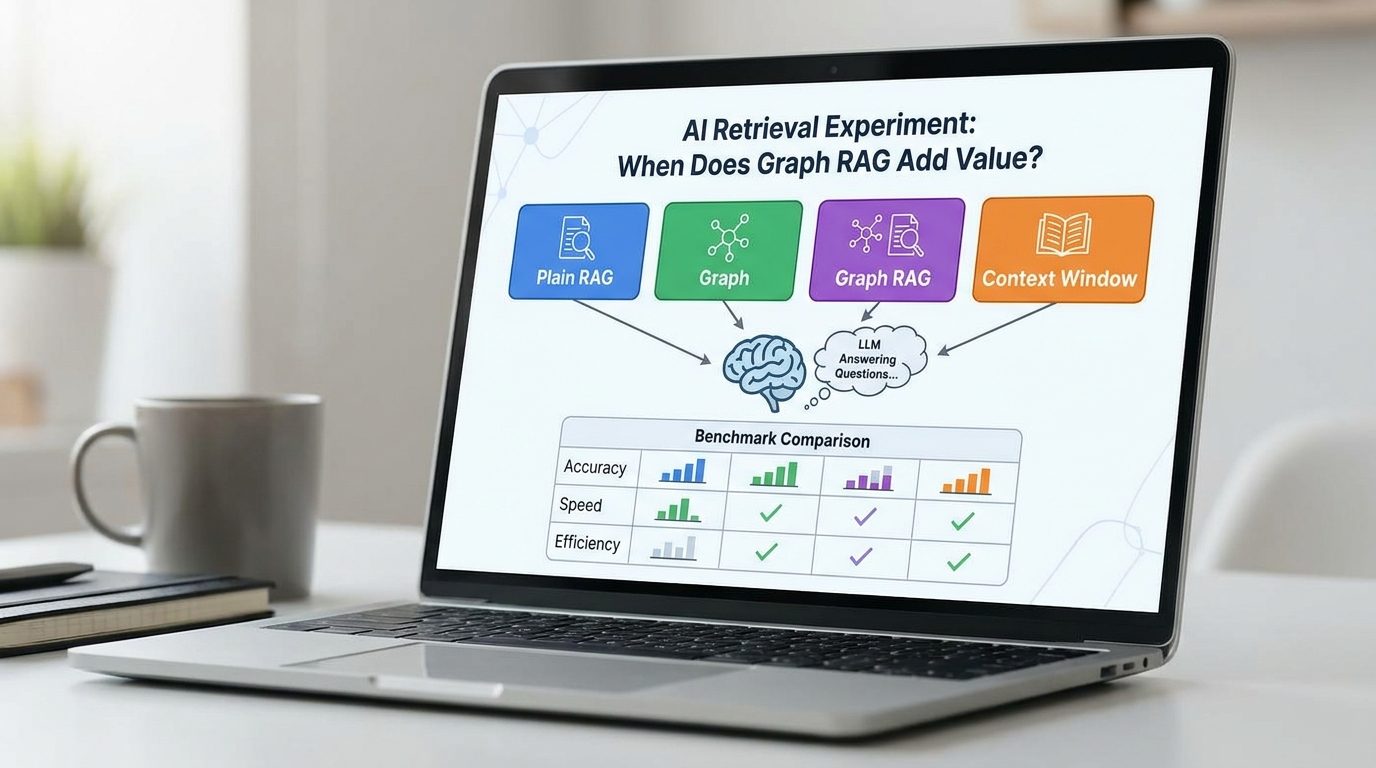
A practitioner benchmark published on Towards Data Science has put four retrieval architectures through the same test: plain retrieval-augmented generation, graph RAG, and feeding entire document sets directly into a frontier model's context window. The experiment, run entirely on a laptop against one fixed corpus and one fixed question set, was designed to isolate where graph-based retrieval earns its added complexity and where it does not. The short answer from the write-up: graph RAG is not a default upgrade, and long-context stuffing is a more serious competitor than many teams assume.
The setup matters as much as the verdict. By holding documents and questions constant, the author removed the variables that usually make architecture comparisons useless — different corpora, different prompts, different evaluation criteria. Four pipelines, one machine, one benchmark. That constraint is the experiment's main strength: any performance gap can be traced to the retrieval design rather than to infrastructure or data drift. It also means the findings are directional rather than universal, since a single corpus cannot represent every production workload.
Graph RAG's pitch has always been relational: build a knowledge graph over your documents so the retriever can follow entity links and multi-hop connections that flat vector search misses. That advantage should show up on questions requiring synthesis across several documents. Where it does not show up is on straightforward lookups, and the benchmark suggests those may be the majority of real queries. Building and maintaining the graph carries extraction, storage and latency costs that flat retrieval avoids entirely.
The frontier-model baseline complicates the picture further. Dropping whole documents into a large context window sidesteps retrieval errors altogether, and for corpora that fit, it can match or beat both RAG variants without any indexing pipeline. The trade-off is cost per query and the hard ceiling on how much text fits. Teams weighing graph RAG against long context are really choosing between paying at index time or paying at inference time, and the benchmark gives at least some evidence for when each bill is worth it.
None of this settles the question, and the author does not claim it does. A laptop benchmark on one document set cannot predict behavior on a million-document enterprise corpus, and graph construction quality varies wildly with the extraction model used. What the experiment does provide is a repeatable template: fix the corpus, fix the questions, run every architecture, and measure. For teams currently defaulting to graph RAG because it sounds more advanced, that template is the useful part.
The next step is replication at scale. The open questions are how graph RAG's edge changes as the corpus grows past what any context window can hold, and whether cheaper long-context inference eventually erases the remaining gap. Until someone runs those numbers on production-sized data, architecture choices will keep resting on vendor claims and intuition rather than measurement.