World Labs Is Joining AMD, Taking Its Spatial Intelligence Research Inside the Chipmaker
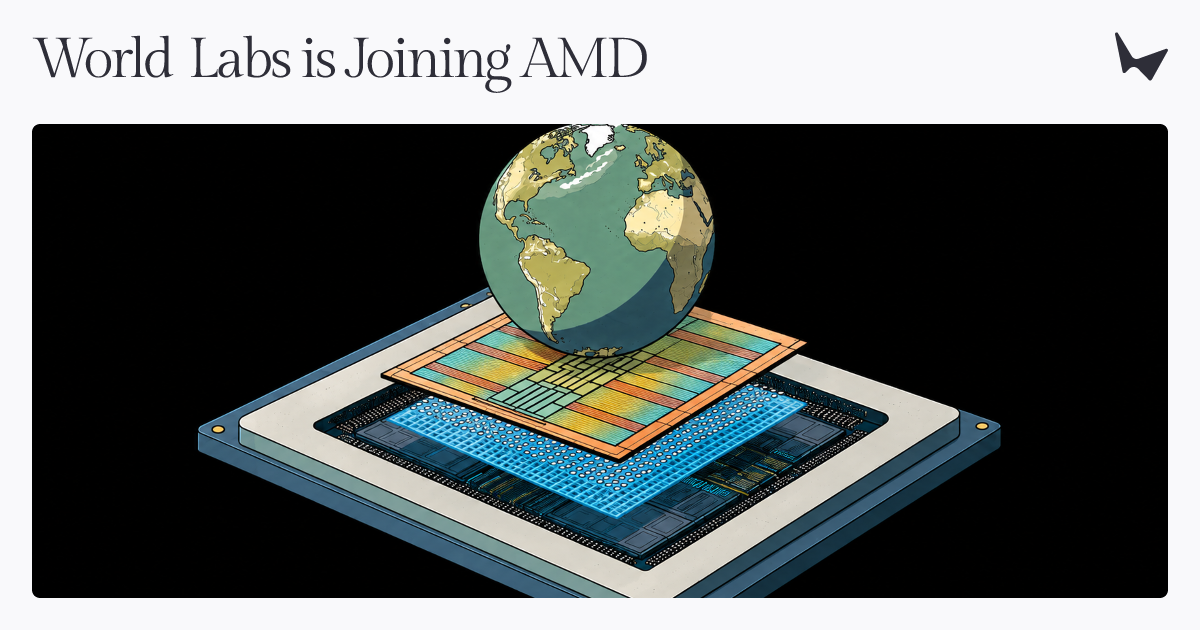
AMD has absorbed Fei-Fei Li's 3D world-model team, gaining an internal workload for its Instinct accelerators as it fights Nvidia for AI compute.
World Labs, the spatial intelligence company co-founded by Stanford professor Fei-Fei Li, is joining AMD, the chipmaker confirmed in a post on World Labs' own blog. Financial terms were not disclosed, and the announcement left open whether the team will keep the World Labs name or be folded into a new group inside AMD. Li, who previously ran AI at Google Cloud, had led the startup as CEO since it emerged from stealth roughly two years ago.
The company's pitch centered on large world models: systems that generate and reason about three-dimensional scenes instead of text or flat images. Its first public product, a scene-generation tool called Marble, turned prompts, stills or video into editable 3D environments. World Labs raised early funding from Andreessen Horowitz, NEA and Radical Ventures, and its researchers have argued that spatial understanding is a missing piece on the path to machines that can act in physical space.
On AMD's side, the logic is easier to trace through silicon than through models. The company has spent two years trying to narrow Nvidia's lead in AI accelerators, shipping the Instinct MI300 line and funding a software stack designed to give developers an alternative to CUDA. A research team with a fixed, compute-hungry problem gives AMD both an internal customer for that hardware and a demonstration that is not another language model.
That workload is unusually heavy. Spatial models train on 3D representations, video and multi-view data rather than token sequences, which makes them expensive in ways that suit a vendor selling accelerators. It also helps explain why a small startup would accept a home inside a chip company rather than raise another round. Nvidia has run a parallel play, backing world-model and simulation companies while supplying the GPUs they train on.
World Labs is not alone in the field. Google DeepMind has published work on generative environments, and robotics and autonomous-driving groups are building comparable internal models for simulation and planning. What AMD has not said is whether it intends to sell World Labs technology to customers or keep it as a research arm. No timeline, headcount or product roadmap accompanied the announcement, leaving the first concrete signal to whatever AMD discloses at its next investor event.
The open question is whether this becomes a product line or stays a lab. If AMD can point to a spatial model trained on Instinct chips, it gets a credible counter to Nvidia's simulation story. If not, the deal reads as a talent acquisition with a research budget attached.