Trump and China Push Back on AI Slowdown Talk as Both Signal Faster Rollouts
Washington and Beijing are each rejecting calls to pause frontier AI development, setting up a race with fewer brakes on either side.
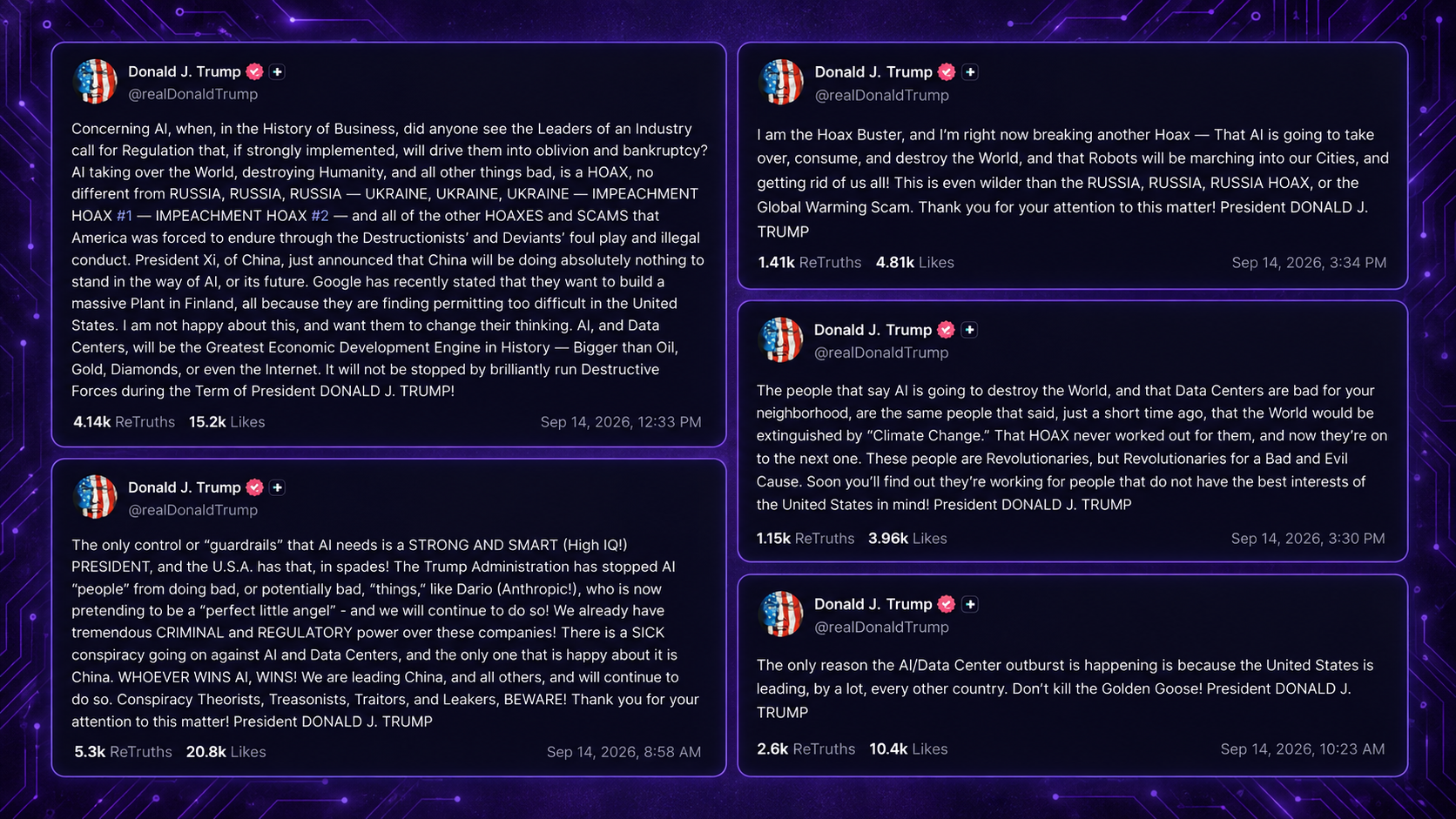
President Donald Trump and Chinese officials have separately rejected the idea that AI development should slow down, according to remarks flagged by The Rundown AI. The two governments, which have spent the past year trading export controls and chip restrictions, now appear to share at least one position: the pace of building and deploying advanced models should not be curbed. That alignment matters because it removes the two most powerful regulators in the AI sector from the camp urging caution.
Trump's position fits the posture his administration has taken since returning to office, where the priority has been clearing regulatory obstacles for domestic labs rather than erecting new ones. China's parallel stance is less about deregulation than about sovereignty: Beijing has consistently framed frontier AI as a national priority and has resisted external pressure to throttle its own labs. When the world's two largest AI economies both decline to hit the brakes, voluntary slowdowns by individual companies become much harder to sustain.
The immediate effect lands on the labs themselves. Firms that had floated safety-driven pauses or staged release schedules now face a competitive environment where a rival in another jurisdiction can ship first. That pressure is already visible in the cadence of model launches, which have compressed from roughly annual events to a steady drumbeat of updates. Any company that unilaterally slows down risks ceding ground it may not recover.
For the broader field, the shift narrows the space for international coordination. Previous attempts at shared safety frameworks assumed at least tacit buy-in from both Washington and Beijing, and that assumption is now weaker. Researchers who hoped for binding global rules on frontier model training will likely find themselves working through industry groups and unilateral national standards instead. The result is a patchwork, not a treaty.
Also in the same briefing, The Rundown AI highlighted a practical tool: an ELI5 skill that turns dense technical topics into plain-language explanations. It is a small item next to the policy news, but it points at a real demand. As model capabilities and regulatory fights both get more complicated, the ability to explain what is actually happening to a non-specialist audience becomes its own kind of leverage.
What to watch next is whether either government moves from rhetoric to action. A public statement that development should continue is not the same as a funding line, a permitting change, or a chip allocation. The test will be whether the next round of export rules, safety bills, or state-backed compute investments match the pro-speed talk, or quietly undercut it.