Tai-dr Launches 'Too AI; Didn't Read' to Flag Machine-Written Text
A new site called Tai-dr is betting readers want a warning label on AI-generated writing, and Hacker News commenters spent the day arguing about whether that is possible.
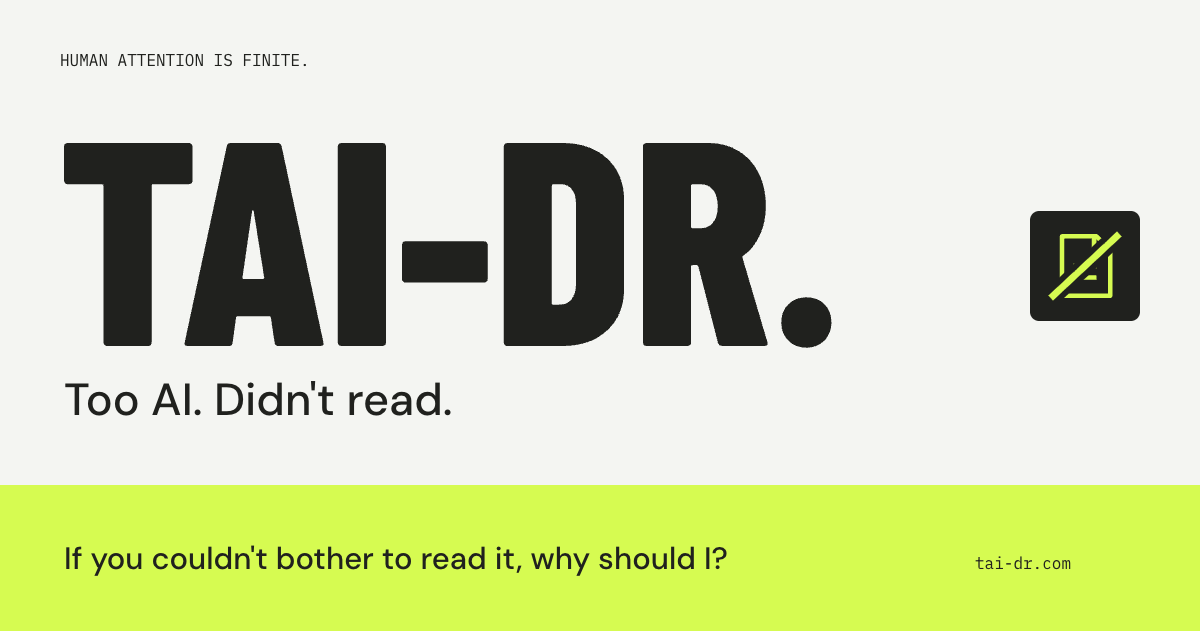
A project called Tai-dr has launched a site at tai-dr.com that borrows the old "tl;dr" shorthand and turns it into "Too AI; Didn't Read" — a label meant to flag text produced by a language model rather than a person. The link hit the front page of Hacker News and drew 106 points and 102 comments, putting it in front of the site's unusually skeptical technical audience for most of the day.
The premise is simple: readers increasingly cannot tell whether a paragraph, email or article was written by a human, and Tai-dr positions itself as a way to mark that distinction before someone spends time on it. The name riffs on the internet's long-running "too long; didn't read" convention, which readers use to skip long posts. Tai-dr substitutes a different reason to skip — suspected machine authorship — which is a sharper accusation than length.
That framing landed in a crowded field. AI-text detectors from companies such as OpenAI, Originality.ai and GPTZero have spent three years promising the same thing, with mixed results. Studies and independent tests have repeatedly shown that detectors misfire on non-native English writers and on heavily edited human prose, and OpenAI retired its own classifier in 2023 after citing low accuracy. Any service that labels text as machine-made inherits that accuracy problem whether it calls itself a detector or a warning label.
The Hacker News thread, which is where most of the reaction is happening, reflects the split. Commenters questioned how Tai-dr decides what counts as AI-written, whether the judgment is automated or human, and what happens when it is wrong — a false label on a person's work is a reputational hit, not just a bad tag. Others argued the more useful signal is provenance, such as signed content credentials, rather than a verdict on style.
For the AI industry, the launch matters less as a product than as evidence of demand. If readers want a marker for machine text badly enough to share a tool like this to the top of Hacker News, the pressure on publishers, model providers and platforms to ship real provenance standards grows. Tai-dr is small, but the appetite it is testing is not.
What to watch next is whether Tai-dr publishes its method and its error rates — the numbers that would separate it from the detector wave that came before. Without that, "Too AI; Didn't Read" is a slogan. With it, it could become the kind of label readers actually trust.