Sunk Cost Calculator Tests When a Local LLM Rig Actually Beats Pay-Per-Token APIs
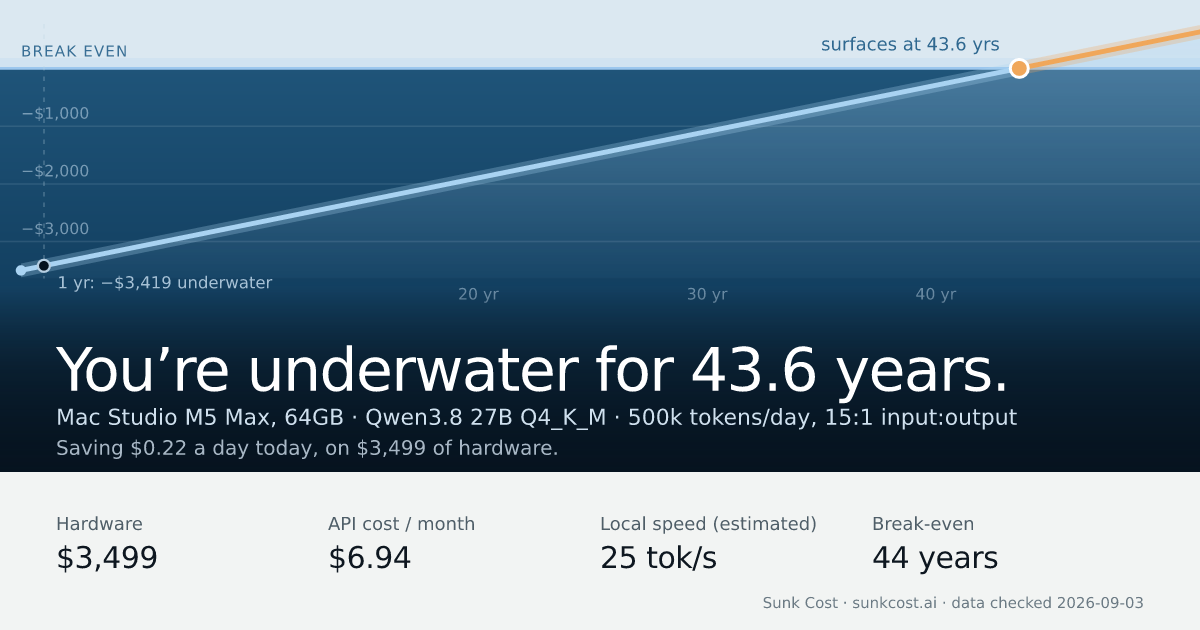
A new Hacker News tool compares the cost of buying and running local inference hardware against renting the same model by the token, and reports the break-even date.
A developer has released a small web tool called Sunk Cost that answers a question that gets tossed around in every local-model thread: if you buy the hardware, how long before it costs less than paying an API by the token? The project takes three inputs — a machine, a model, and your daily token consumption — and returns a payback period. It was posted to Hacker News, where it drew 30 points and 31 comments as of publication.
The premise the tool pushes back on is the common advice to "just buy a Mac and run models locally, it pays for itself." That claim circulates constantly in developer communities, but it is almost never checked against actual usage numbers. Sunk Cost makes the arithmetic explicit: you supply your own token volume, and the tool compares the amortized hardware cost against what the same model would cost per token from a hosted provider.
The mechanics matter more than the interface here. Payback depends heavily on which model you run and how many tokens you burn per day, so the same machine can look like a bargain for one user and a money pit for another. Someone pushing a few million tokens a day through a mid-range GPU box will cross the break-even line far sooner than a hobbyist running a few prompts on a laptop. The tool does not attempt to price electricity, depreciation, or the time spent maintaining a local stack, which means its output is closer to a best case than a full accounting.
The author is upfront about that narrow scope. In the project description, they note that there are plenty of non-financial reasons to own your own hardware — privacy, offline access, no rate limits, no vendor policy changes — but that Sunk Cost deliberately ignores all of them and looks only at raw cost savings. That framing is the honest part of the exercise: the tool is not arguing against local inference, it is arguing against using a cost claim to justify it without doing the math.
The timing is not accidental. Hosted inference prices have fallen repeatedly over the past two years, while consumer and workstation GPUs have stayed expensive, which squeezes the window in which owning hardware wins on price alone. At the same time, open-weight models keep getting better at smaller sizes, so the hardware needed to run something useful keeps drifting downward. Both trends move the break-even point, and they move it in opposite directions depending on which model and provider you pick.
The obvious next step is for the tool to incorporate the costs it currently leaves out — power draw, idle time, and the resale value of the hardware after a couple of years. The author has asked for suggestions on how to make it more useful, and the comment thread is where that conversation is happening. The open question is whether a single break-even number is even the right output, or whether users need a range that reflects how much their token usage is likely to swing month to month.