QCon San Francisco 2026 Lines Up Airbnb, OpenAI, Netflix Engineers to Talk Agent-Era Production Systems
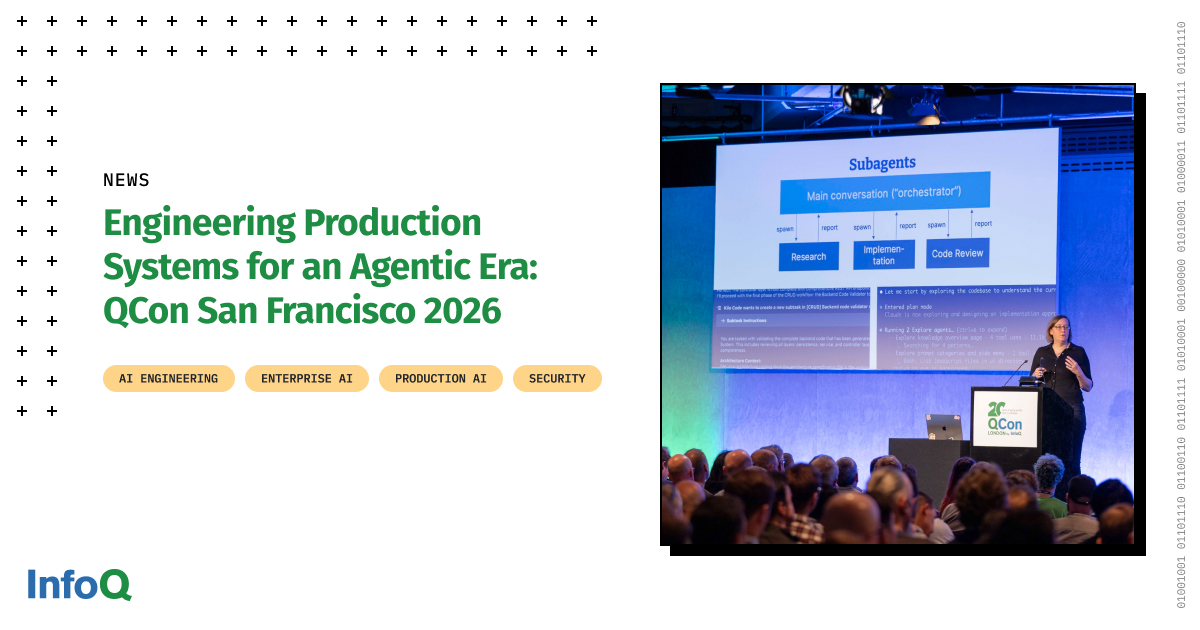
QCon San Francisco 2026 will gather engineers from Airbnb, OpenAI, Netflix and Honeycomb to explain how production systems are being rebuilt around AI agents, organizer Artenisa Chatziou said.
QCon San Francisco 2026 will put the operational side of AI agents on the main stage, with engineers from Airbnb, OpenAI, Netflix and Honeycomb among the practitioners scheduled to present. Organizer Artenisa Chatziou framed the program around a single problem: how teams build, run and keep changing production systems once agents carry more of the workload. The conference returns to San Francisco with a roster drawn from companies that already run agents against live traffic rather than in demos.
The speaker list matters because the hardest questions in agent deployment are operational, not conceptual. Airbnb, Netflix and Honeycomb all operate large distributed systems where a single bad rollout can surface as customer-visible failure, and OpenAI runs inference infrastructure at a scale few others match. Their engineers are being asked to explain what changes when a non-deterministic component sits inside a request path that previously behaved the same way every time.
That shift forces teams to rethink observability, rollback and cost control at once. Traditional dashboards assume a known set of failure modes, but an agent can fail by producing a plausible wrong answer, calling the wrong tool, or looping until a budget cap trips. Honeycomb's presence points to the telemetry side of the problem, while the Netflix and Airbnb talks point to deployment and platform work. Expect concrete numbers on latency, spend and incident rates rather than architecture diagrams alone.
The timing lines up with a broader recalibration across the industry. After two years of agent prototypes, engineering leaders are being pushed to justify what actually reaches production and what stays behind a feature flag. QCon's format, which favors practitioner experience over vendor pitches, tends to surface those unglamorous details, including the internal platforms and guardrails teams built when off-the-shelf tools fell short. Chatziou's summary suggests the 2026 edition leans into that operational realism.
For engineers deciding how to spend their tooling budget, the sessions to watch will be the ones covering evaluation, incident response and human review in agent workflows. The open question is whether the patterns described will generalize beyond the handful of companies with dedicated platform teams, or remain the preserve of large engineering organizations. QCon San Francisco 2026 is where those claims will be tested in public.