Permutation Symmetry: The Hidden Obstacle to Neural Network Averaging
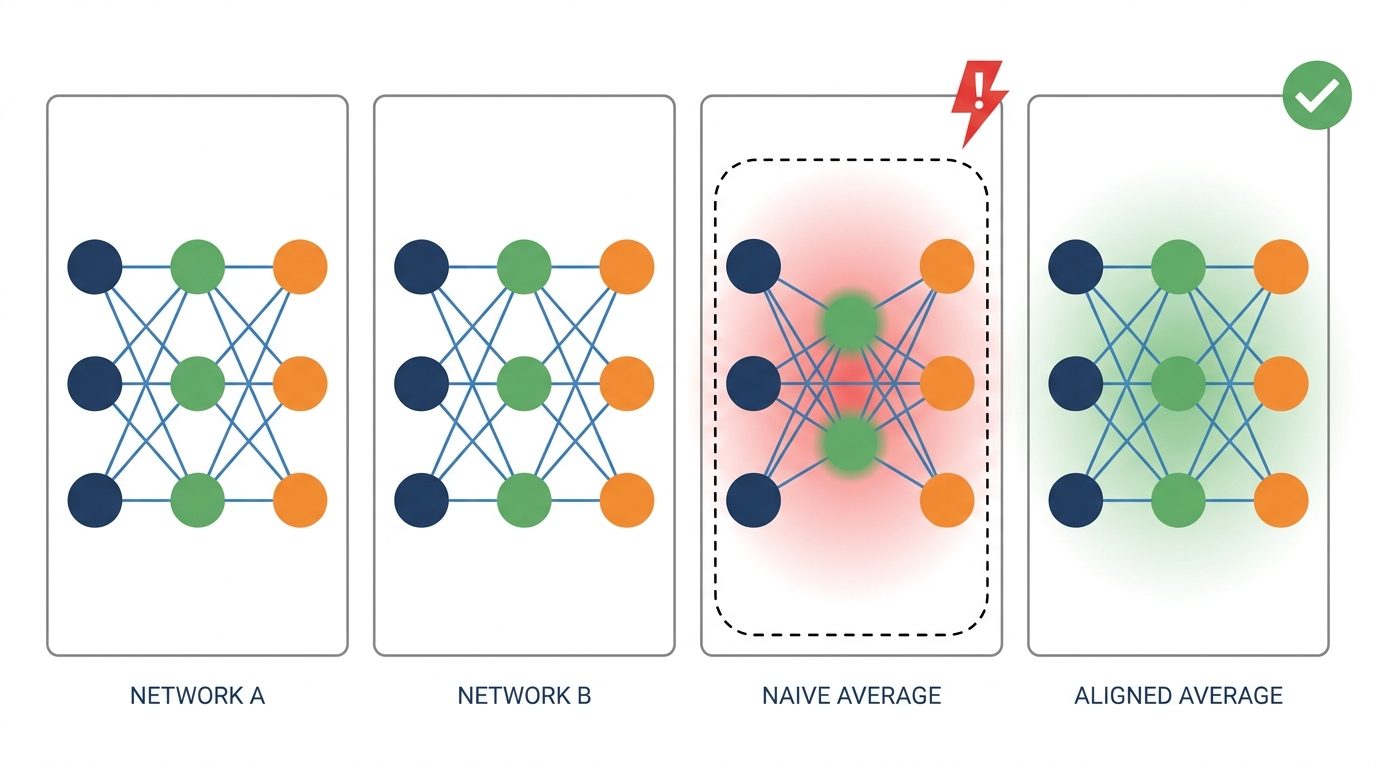
New analysis explains why combining trained neural networks by averaging their weights often fails, pointing to permutation symmetry as the root cause.
Averaging the weights of two trained neural networks sounds like a simple way to combine their knowledge, but it frequently produces a model that performs no better than random guessing. A recent technical analysis from Towards Data Science lays the blame on permutation symmetry—a property of neural networks that allows many different weight configurations to represent the same function. The article explains that when two networks are trained independently, their internal arrangements of neurons are likely to be permuted versions of each other, making a direct weight average mathematically meaningless.
The core issue is that neural networks are highly redundant. A network with fully connected layers can have its neurons shuffled in ways that leave its outputs unchanged, provided the weights are rearranged accordingly. Two separately trained networks will almost never align these permutations, so averaging their weights corresponds to mixing incompatible parameterizations. The result is a set of weights that does not map to any coherent function, effectively destroying the network's learned behavior.
This problem has practical consequences for model merging, an increasingly popular technique for combining fine-tuned models or ensemble members without retraining. Researchers have observed that simple weight averaging works only when models share the same initialization or are very similar, which sidesteps the permutation issue. The analysis clarifies why more advanced merging methods often require aligning the models' internal symmetries first, a step that is computationally expensive and not always straightforward.
The concept of permutation symmetry is not new—it has been studied in the context of neural network loss landscapes and optimization. But its central role in weight averaging has only become a focus as researchers push toward more efficient ways to reuse trained models. The article points out that understanding these symmetries is key to designing algorithms that can reliably combine models, whether for federated learning, ensemble distillation, or continual learning.
For practitioners, the takeaway is caution: naive weight averaging should not be expected to work across independently trained models. Instead, the analysis suggests that successful merging requires either training models with symmetry-aware objectives or using post-hoc alignment techniques that match neuron permutations. The author notes that recent work on permutation alignment has shown promise, but it remains an open area of research.
Looking ahead, the article hints at a deeper question: if permutation symmetry breaks averaging, what other symmetries might be at play? Neural networks may exhibit additional invariances beyond neuron shuffling, such as scaling symmetries, that could further complicate model merging. As the field moves toward more modular and reusable AI systems, solving these symmetries could be as important as the optimization algorithms themselves.
The full analysis is available on Towards Data Science, offering a technical deep dive for readers familiar with linear algebra and neural network internals. For now, the message is clear: weight averaging is not a universal tool, and the reason lies in the very structure of neural networks themselves.