Pangram Launches AI Detector That Flags Machine-Written Text and Images Alike
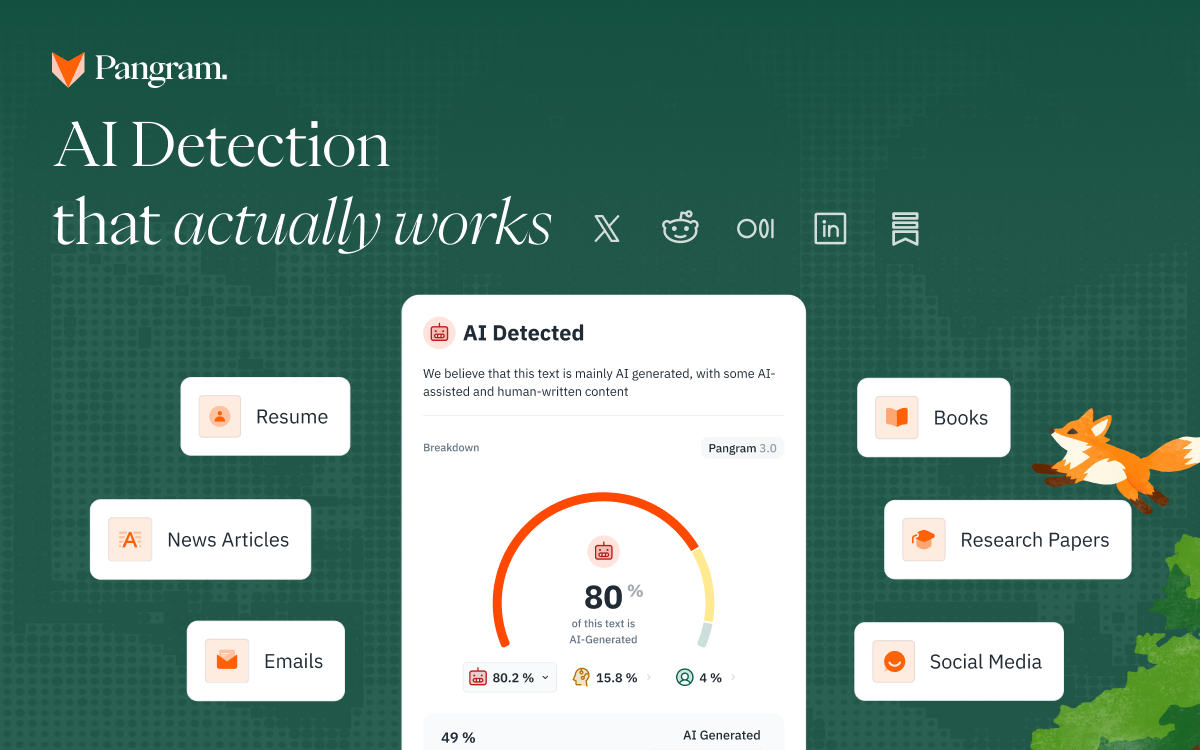
Pangram is selling a single detector for machine-written prose and AI-generated images, a dual-format bet most competitors have split between separate vendors.
Pangram has launched an AI detection service that checks both written content and images, positioning itself against a market where most rivals pick one format and stay there. The tool lives at pangram.com and aims at the same buyer question that publishers, teachers and platform trust teams keep asking: was this made by a person or a model? The company has not published accuracy figures, training details or how it handles edited content.
The split it is trying to close is real. GPTZero and Originality.ai score prose for the statistical fingerprints left by large language models, while Hive and Reality Defender lean on pixel artifacts and provenance metadata to flag synthetic images. Buyers who need both today run two contracts and two dashboards. Pangram's pitch is that one service covers the pair, which matters because a single misleading post often pairs a generated paragraph with a generated illustration.
The engineering on each side is genuinely different, which is why few vendors attempt both. Text detection reads token probabilities and perplexity patterns, and it weakens once a model paraphrases or a human edits the output. Image detection hunts for diffusion artifacts, frequency-domain traces and generator metadata from systems like Midjourney or DALL-E, and it breaks after a screenshot or a re-compression. A vendor covering both formats has to run two pipelines and keep each current as new model versions ship, a treadmill that has already sunk earlier entrants.
Accuracy is the fault line. Studies have repeatedly found false-positive rates high enough to wrongly accuse students, and OpenAI retired its own classifier in 2023 after calling it unreliable. Enterprise buyers now want benchmarks on out-of-distribution models rather than results from a vendor's own test set. Whether Pangram publishes third-party evaluations, and how it treats mixed human-AI drafts, will decide whether trust and safety teams take it seriously.
The launch also lands in a shifting policy climate. Disclosure requirements under the EU AI Act and several state bills push platforms toward labeling synthetic media, which creates demand for exactly this kind of tooling. At the same time, provenance standards like C2PA try to solve the problem at the point of creation instead of after the fact, a route that could make retroactive detectors less necessary. Detection vendors counter that most content still arrives with no credentials attached.
What to watch next is evidence. Pangram has not detailed its accuracy numbers, its training data or its handling of adversarial edits. If the company releases independent benchmark results and shows the image side holding up against common laundering tricks, it could carve out room against single-format rivals. If it stays quiet on methodology, it joins a long line of detectors that looked convincing in a demo and faltered in the wild.