Ollaya Brings Jev-Style Decision Models to Open-Source Runtimes, Drawing 333 Points on Hacker News
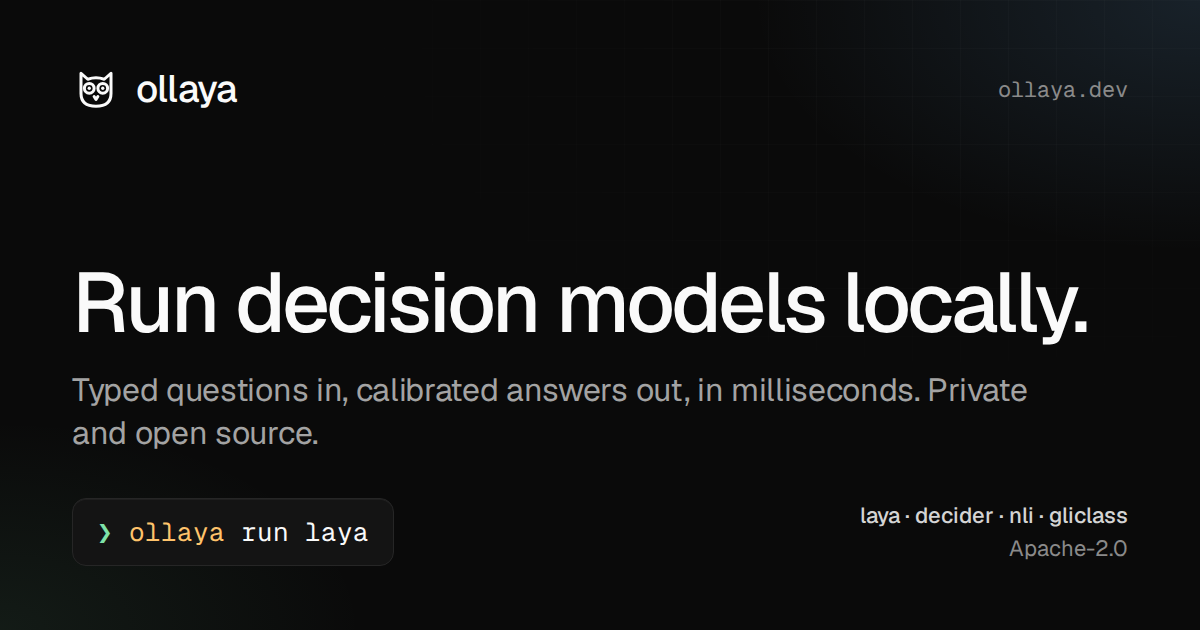
A new project called Ollaya is pitching itself as the Ollama equivalent for open-source decision models in the Jev tradition, and Hacker News noticed.
A project calling itself Ollaya surfaced on Hacker News this week with a direct pitch: run open-source decision models the way Ollama runs language models. The submission, posted at ollaya.dev, pulled 333 points and 98 comments, enough to push it near the top of the front page and into the feeds of developers who track local-inference tooling. The core claim, per the project page, is that Ollaya targets Jev-style decision models rather than the transformer-based LLMs that dominate the current tooling wave.
The name is the giveaway. Ollama became the default on-ramp for people who wanted to pull a model and run it on their own machine without wrestling with Python environments, CUDA versions or vendor SDKs. Ollaya appears to be betting that the same friction now exists for decision models, and that a thin, opinionated command-line layer can remove it. The project's framing suggests a single runtime that handles model fetching, weights and execution for open-source decision models, mirroring the pull-and-run ergonomics that made its namesake popular.
Jev-style decision models are a narrower and less commercialized category than generative LLMs, which makes the tooling gap more acute. Practitioners in that space have historically stitched together research code, per-paper repositories and bespoke inference scripts, so reproducibility suffers and onboarding takes days rather than minutes. If Ollaya delivers even a partial abstraction over that mess, it addresses a real pain point rather than a marketing one. The 98-comment thread is a reasonable proxy for how much appetite exists: enough to argue about, not enough to declare a standard.
What the thread does not yet settle is whether Ollaya is a genuine runtime or a wrapper around existing libraries with a friendlier front end. Hacker News commenters have a well-documented habit of pulling projects apart on exactly this question, and 333 points without a corresponding wave of independent benchmarks or third-party writeups leaves the performance claims unverified. There is also no indication yet of which model formats, hardware backends or operating systems are supported, details that decide whether a tool gets adopted or abandoned within a week.
The comparison to Ollama cuts both ways. Ollama succeeded because it arrived when local LLM inference was painful and it stayed small, fast and predictable; imitators that added configuration surface or drifted from that simplicity lost users quickly. Ollaya will be judged on the same terms, and the decision-model community is smaller and more technical than the LLM crowd, so sloppy defaults will be noticed faster. Whether the project publishes benchmarks, a supported-model list and a stable release cadence in the coming weeks is the thing to watch.
For now, Ollaya is a promising signal more than a proven tool. A front-page run on Hacker News buys attention, not adoption, and the project's own site is the only substantial source on what it actually does. The open question is straightforward: can a single-command runtime do for Jev-style decision models what Ollama did for local LLMs, or does that category's heterogeneity resist the kind of standardization the pitch implies?