Nebius and Nvidia Open 2026 Physical AI Awards, Five Startups to Win $150K in Compute Credits
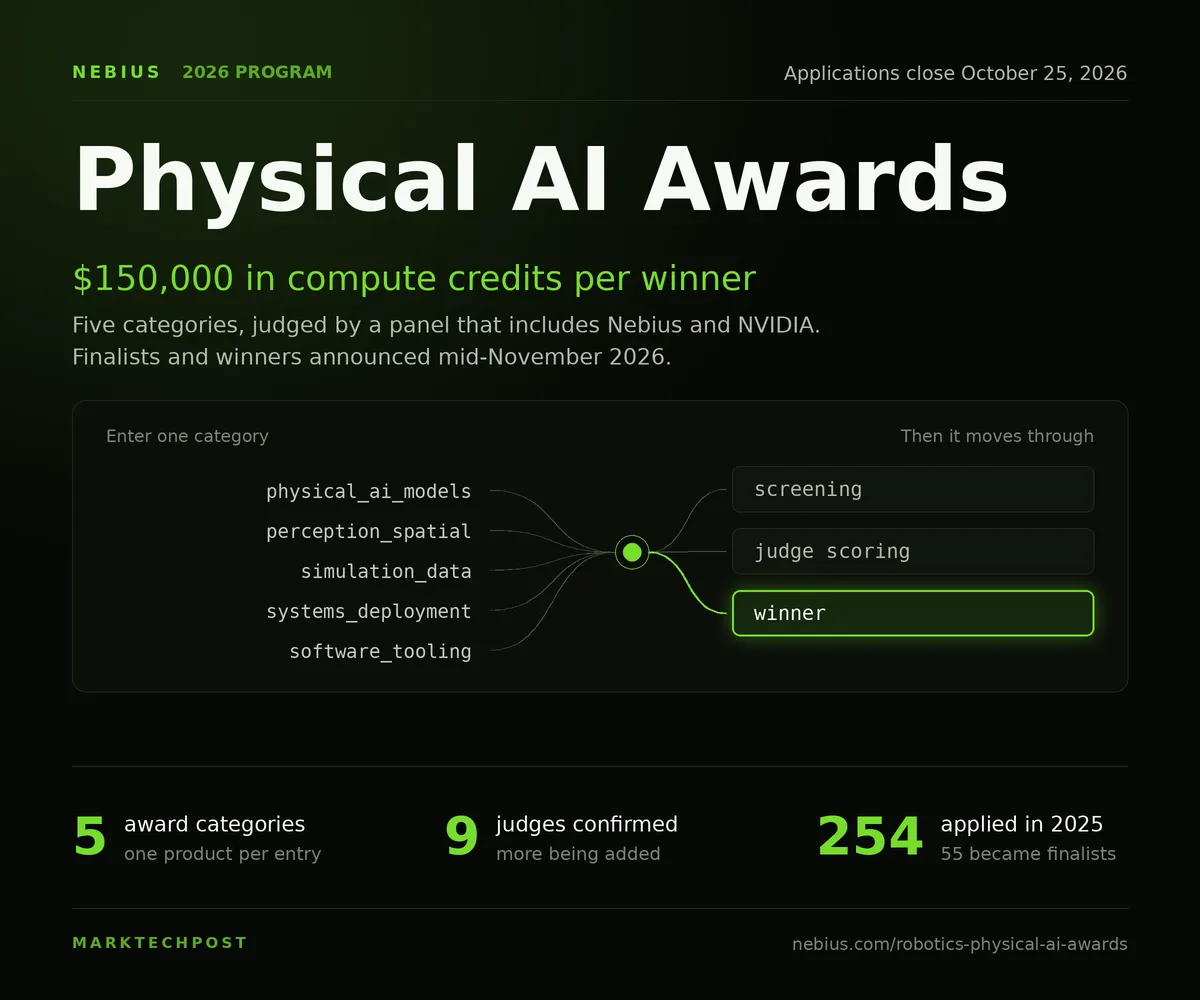
Startups building physical AI products have until October 25 to apply for five prizes that each include $150,000 in Nebius compute credits, joint marketing with Nvidia, and executive mentorship.
Nebius and Nvidia are taking applications for the 2026 Physical AI Awards, a contest aimed at early-stage companies whose products operate in the physical world. Five category winners will each receive $150,000 in compute credits on Nebius infrastructure, along with joint promotional support from both sponsors, mentorship from their executives, and seats at an executive dinner. The application window closes October 25, with no entry fee mentioned in the announcement.
The prize package is weighted heavily toward compute rather than cash, which reflects how the economics of training and running physical AI systems have shifted. Robotics and embodied-AI startups burn through GPU hours for simulation, reinforcement learning, and perception model training, and a $150,000 credit line can cover a meaningful stretch of that work. Pairing the credits with Nvidia's involvement also signals that winners will get access to the hardware ecosystem most of these teams already build on.
The mentorship and dinner components matter as much as the credits for companies at this stage. Early physical AI teams often have strong research backgrounds but thin go-to-market experience, and direct access to executives at a cloud provider and a chipmaker can shortcut partnership and procurement conversations. Joint promotion gives winners visibility with enterprise buyers and investors who watch both companies' developer programs.
Nebius, spun out of Yandex and listed in the U.S., has been positioning itself as a GPU cloud built for AI workloads, and Nvidia's co-sponsorship gives the awards credibility with startups comparing cloud options. The physical AI framing is deliberate: the category covers robots, autonomous machines, and other systems that sense and act in real environments, a segment attracting rising investment as foundation-model techniques move from screens into hardware.
The October 25 deadline leaves applicants roughly a few weeks to submit, and the five-category structure suggests the sponsors want breadth rather than a single overall winner. What remains unclear is how the categories break down, how winners are judged, and whether the credits carry expiration dates or usage restrictions. Startups weighing an application should watch for those terms, since the real value of a $150,000 compute prize depends on how freely it can be spent.