InfoQ Podcast Panel Weighs Enterprise AI Adoption Against Push for Open Source Sovereignty
Three practitioners unpack why companies are racing to deploy AI, where reliability and ethics fit in, and how software engineering roles are shifting.
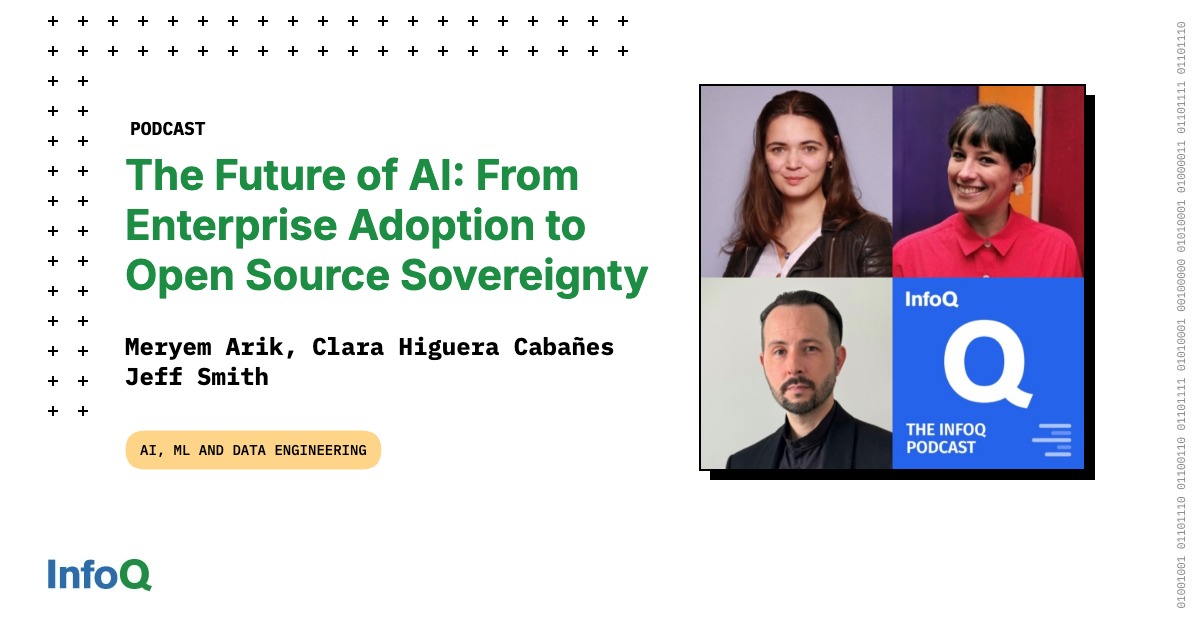
InfoQ has published a podcast episode examining how enterprises are absorbing AI tools, with three practitioners arguing that the current moment amounts to an industrial revolution for corporate software. The panel features Meryem Arik, Clara Higuera Cabañes, and Jeff Smith, who spend the hour working through what adoption actually looks like inside large organizations. Their focus is less on model benchmarks than on the operational friction companies hit once pilots move toward production.
The competitive logic driving the rush gets a central hearing. Panelists describe firms treating AI capability as a defensive necessity, not a discretionary experiment, because falling behind rivals on automation or customer-facing features carries real revenue risk. That pressure collides with the messy reality of deploying systems that can behave unpredictably at scale, where a wrong answer in a support queue or a compliance workflow costs more than a slow feature rollout. Arik, Higuera Cabañes, and Smith treat reliability as an engineering problem rather than a vendor promise.
Ethics and governance surface as practical constraints rather than abstract concerns. The conversation covers how teams weigh data provenance, model transparency, and accountability when AI systems touch regulated processes. For engineers, that means new review steps and documentation burdens that traditional software cycles did not require. The panelists position these guardrails as part of the cost of doing business, not obstacles to be routed around.
The episode also takes up the changing shape of software engineering work. As AI-assisted coding tools absorb routine implementation tasks, the panel argues the job tilts toward system design, evaluation, and deciding when a model's output is trustworthy enough to ship. That shift raises questions about which skills employers will hire for and how teams structure review. The discussion ties this directly to the enterprise adoption wave, since tooling choices determine how much of the work gets automated.
Open source sovereignty rounds out the episode, framing it as a counterweight to dependence on a handful of commercial model providers. The panelists explore why some organizations want control over weights, hosting, and update cadence rather than renting capability from a vendor that can change terms or pricing. That tension between convenience and control looks set to define procurement debates over the next year. The open question is whether self-hosted options can match closed models on reliability without demanding engineering resources many enterprises lack.
The episode lands as enterprises sort through a crowded vendor market and growing internal pressure to show returns on AI spending. Listeners looking for concrete guidance will find debate rather than a checklist, but the panel's framing of adoption, ethics, and engineering roles as one connected problem is the throughline. What remains unresolved is how quickly open source alternatives close the capability gap, and whether companies betting on sovereignty can staff the work.