Graphify Turns Codebases Into Queryable Knowledge Graphs for AI Coding Agents
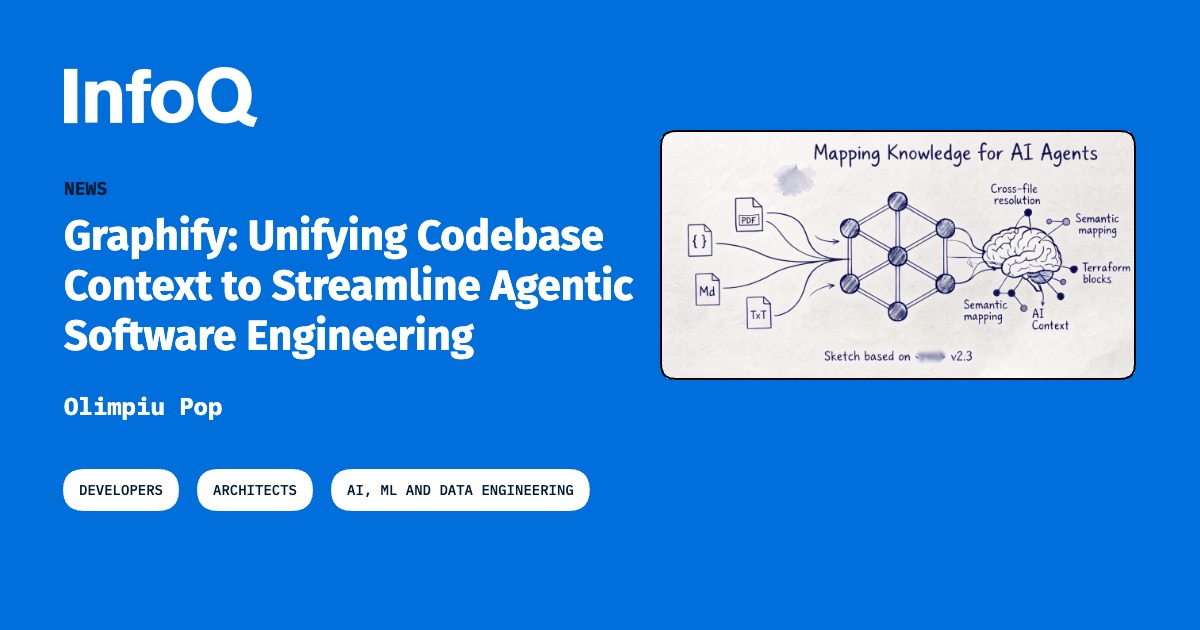
The open-source project aims to fix multi-file reasoning by giving coding assistants a structured graph of a repository instead of raw file dumps.
Graphify, an open-source tool that converts codebases and unstructured data into queryable knowledge graphs, launched in April 2026 and is drawing attention from developers frustrated by how poorly AI coding assistants handle large repositories. The project targets a specific failure mode: agents that reason well inside a single file but lose track of dependencies once a change spans modules, services, or configuration. By representing a repository as a graph rather than a flat pile of text, Graphify gives those agents a structured index to query.
The core problem is one anyone who has pointed an assistant at a monorepo will recognize. Context windows are finite, and stuffing an entire codebase into a prompt is both expensive and unreliable, so agents typically see a handful of files and guess at the rest. Multi-file reasoning breaks down exactly where software engineering gets hard: tracing a function call across packages, following a type through several layers, or spotting that a config value is read in a service nobody remembered. Graphify's answer is to parse the code once, build a graph of entities and their relationships, and let the agent retrieve only what a task needs.
Recent updates have focused on the unglamorous work that determines whether that idea holds up. The team has expanded parser features and improved cross-file resolution, the part of the pipeline responsible for linking a symbol defined in one file to its uses in another. That resolution step is where graph-based tools tend to succeed or fail, since languages with dynamic imports, generated code, or heavy metaprogramming resist static analysis. Unstructured data also sits in scope, which suggests the project is aiming at repositories where documentation, schemas, and config files matter as much as source code.
Early community response has been mixed but engaged. Developers describe the architecture as promising, and the appeal is easy to see: a persistent, queryable model of a codebase is a more natural substrate for agentic workflows than repeated full-context prompting. The recurring complaint is integration. Fitting a graph build and query layer into an existing daily loop, with its editors, CI pipelines, and existing agent frameworks, takes effort that many teams are not ready to spend. Feedback so far points to friction in adoption rather than flaws in the underlying design.
That gap between a good architecture and a tool people actually keep open is the familiar hurdle for developer infrastructure. Graphify is not the only project chasing structured code context, and competing approaches range from embedding-based retrieval to language-server-style symbol indexes, each with different tradeoffs in accuracy, build time, and setup cost. What could separate Graphify is how well its graphs stay current as code changes, since a stale index is worse than none for an agent making edits.
What to watch next is whether the project can shrink the setup burden and prove measurable gains on real multi-file tasks, not benchmark puzzles. Concrete numbers on retrieval accuracy, index freshness, and token savings versus plain context stuffing would answer the skepticism more convincingly than architecture diagrams. Until then, Graphify reads as a well-aimed bet on a real problem, waiting on the integration work that decides whether developers adopt it or merely admire it.