Google Labs Expands AI Agent 'CC' From Solo Users to Whole Families
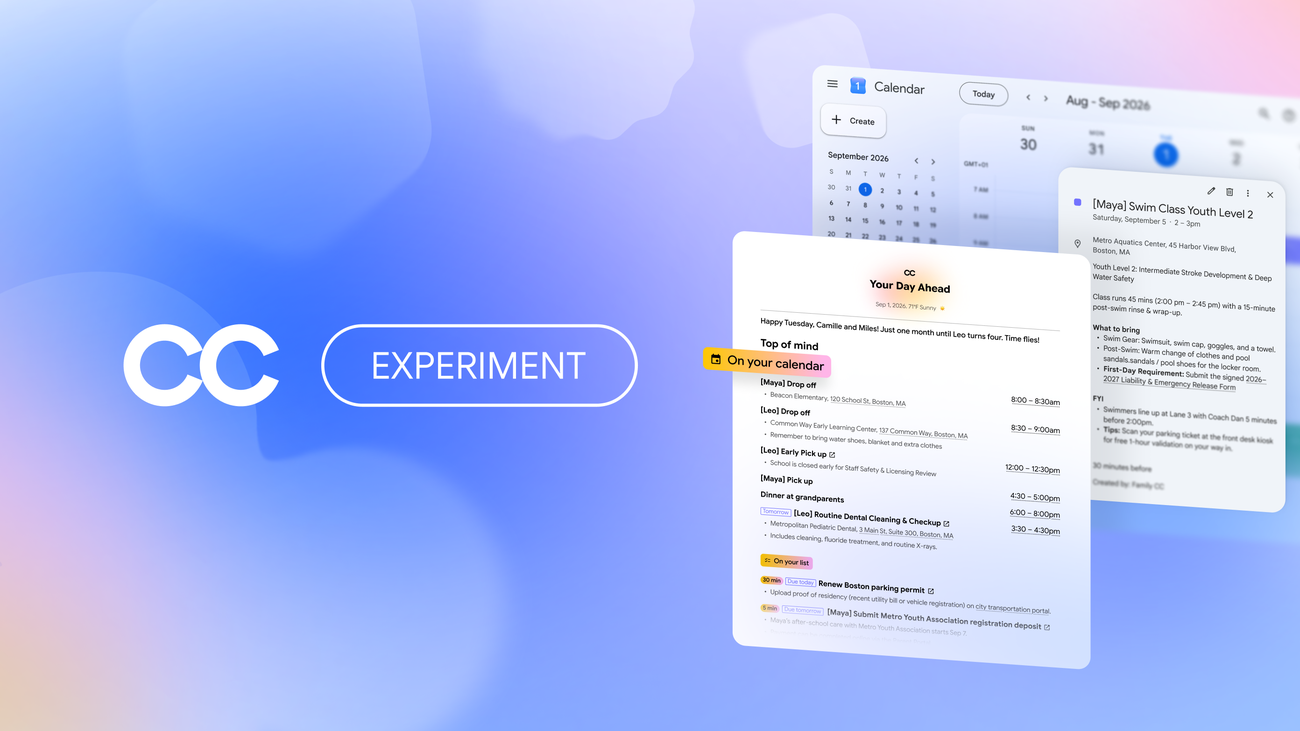
Google Labs is letting multiple people share a single CC agent, shifting the assistant's base unit from one user to a whole household and raising hard questions about permissions and data.
Google Labs is widening access to CC, its AI agent, so that groups rather than single users can operate one shared assistant. The change, detailed on the company's Innovation and AI blog, lets parents, partners and children coordinate schedules, chores and reminders through a common agent instead of separate logins. It marks a move from CC's original framing as a personal organizer toward something closer to household infrastructure.
The shift sounds cosmetic but changes the account model underneath. Almost every mainstream consumer assistant assumes one owner, one login and one set of preferences, an arrangement that collapses as soon as two people need the agent to hold the same facts. Under group support, the unit of account becomes a family or small cluster of people, which is a harder engineering and privacy problem than a single-user rollout. An agent tracking one calendar can be forgiving about context; one tracking a household's calendar has to decide which appointment, list or reminder each member is permitted to see.
The pitch is coordination. A shared agent could hold a grocery list one partner adds to and the other checks off, or track who is picking up a child and when. That territory is already crowded: family calendar apps, shared notes and group messaging threads handle pieces of it without asking anyone to hand household data to a model. Google's bet is that natural-language control and automatic scheduling save enough manual entry to justify the tradeoff.
Google has not said how granular its controls will be, and the early scrutiny has landed on exactly that gap. Shared agents raise questions about permissions, data retention, and what happens when a member leaves the group or when a child's account is involved. Until the company publishes specifics, the feature's appeal to privacy-conscious households remains unresolved.
For Google, the expansion fits a broader push to move agents out of single-user demos and into settings where several people depend on the same output. That is where retention lives, and also where mistakes get costly, since a misread schedule now affects more than one person. Rivals including OpenAI and Anthropic are pursuing adjacent ground, though largely through enterprise and developer channels rather than the family living room.
What to watch next is the permission layer: whether group members get separate identities, whether an admin can revoke access, and whether household context is stored on-device or in the cloud. Google Labs has not published a timeline for wider availability, and the blog post leaves rollout mechanics vague. Those answers will determine whether CC becomes a genuine household utility or another assistant that works fine until a second person tries to use it.