Georgia Tech's Transformer Explainer Turns GPT-2 Into a Live, Clickable Diagram
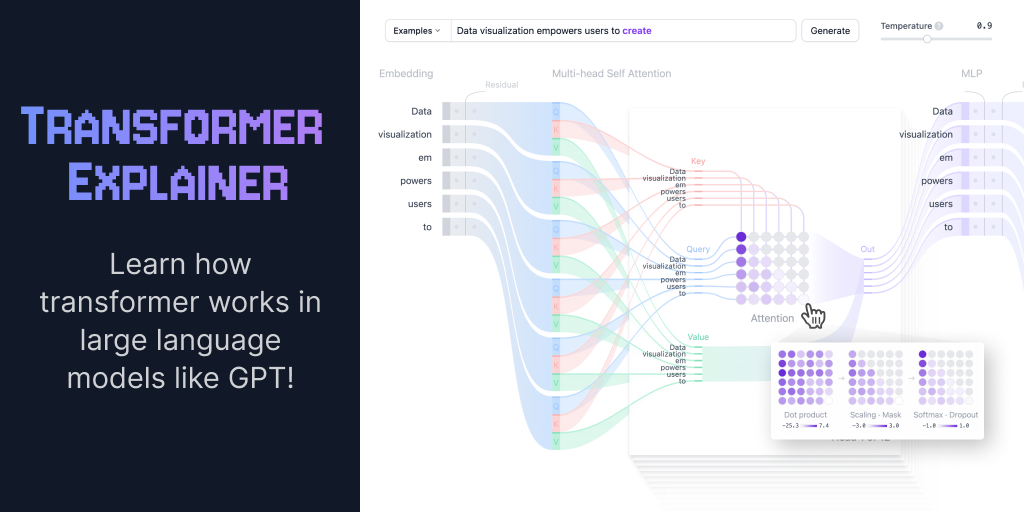
The Polo Club of Data Science has released a free interactive tool that recomputes GPT-2's attention, embeddings and softmax on every keystroke, turning transformer mechanics into something users can poke at rather…
Georgia Tech's Polo Club of Data Science has released Transformer Explainer, a free browser-based tool that runs a live GPT-2 instance on the user's own machine and redraws the model's internals as text is typed. There is no install, no account and no API call: the model executes client-side, so the visualization updates continuously instead of showing a single frozen pass. The project is led by Polo Chau, a computing professor at Georgia Tech whose group has spent years building visual interfaces for machine learning systems.
The explainer splits a forward pass into its component stages — tokenization, token and positional embeddings, the stack of multi-head attention and feed-forward blocks, and the final projection onto the vocabulary. Each stage gets its own view, and users can open individual attention heads to see which earlier tokens a given position is weighting at that moment. As the prompt changes, the probability distribution over the next token shifts on screen, which is the part static diagrams cannot show. GPT-2 is old by current standards, ranging from 124 million to 1.5 billion parameters across checkpoints, but its decoder-only architecture is close enough to today's systems that the mechanics still transfer.
Running inference on-device is what makes this practical. Because nothing is sent to a hosted endpoint, there is no per-token cost and no rate limit, so a classroom or a single learner can experiment as long as they like without a budget. It also means no GPU, Python environment or setup step stands between a curious user and a working model. That combination — real weights plus zero friction — is rarer than it sounds among explainers.
The tool sits in territory already occupied by TensorFlow Playground, BertViz and the essays published at distill.pub, but a live inference demo does something those formats handle less directly: it surfaces failure modes. Users can watch GPT-2 put high probability on a continuation that is plainly wrong, or see how the context window steers later predictions. That gives instructors a concrete artifact for conversations about hallucination and next-token prediction, which often stay abstract when taught from slides.
The obvious limitation is scale. GPT-2's attention patterns are simple enough to render legibly in a browser; a frontier model with hundreds of billions of parameters and mixture-of-experts routing would not fit the same visual grammar, and the group's own prior work on inspecting large language models hints at how much harder that problem gets. What to watch is whether the Polo Club extends the approach to architectures that resemble what people actually deploy, or whether live explainers remain a teaching genre bounded by the models small enough to run locally.
For now the explainer occupies a narrow but useful slot: a hands-on way to see the machinery behind autocomplete without taking anyone's word for how it works.