Forter Turned 200 Employees Into AI Agent Builders in Two Weeks
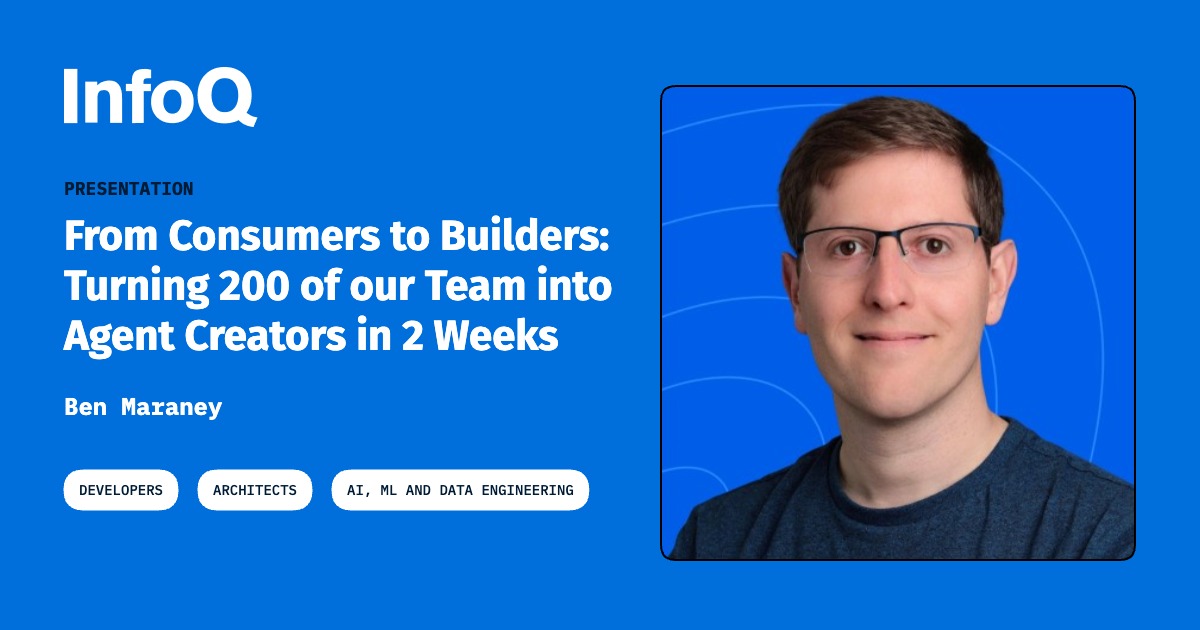
Fraud-prevention firm Forter trained 200 staff across technical and non-technical roles to build AI agents in a two-week push, leaning on custom MCP servers and skipping heavy RAG pipelines.
Forter, the fraud-prevention company, ran a two-week program that turned 200 employees — engineers and non-engineers alike — into builders of AI agents, according to a presentation by Ben Maraney covered by InfoQ. The effort was aimed at R&D staff who had been consumers of AI tools but not creators of them, and it compressed that transition into a single sprint rather than a months-long enablement cycle. For companies still debating whether agent-building should stay with a specialized platform team, Forter's result is a concrete data point in the other direction.
The mechanics leaned on custom MCP servers, the protocol layer that lets agents call tools and data sources without bespoke glue for every integration. Maraney described pairing no-code interfaces with code-based platforms so that different skill levels could participate in the same program: non-technical staff assembled agents through visual tooling, while engineers extended them in code. That dual-track approach is what made the 200-person number plausible — a code-only rollout would have excluded most of the group.
One of the more notable choices was what Forter avoided. The team steered clear of complex RAG, or retrieval-augmented generation, setups, which typically require chunking pipelines, vector stores and ongoing tuning. By sidestepping that infrastructure, Forter cut the time between an employee having an agent idea and shipping something usable, and reduced the number of failure points a first-time builder would hit. The tradeoff is that agents relying on direct tool calls rather than retrieval may handle narrower queries, but for internal R&D use that constraint was evidently acceptable.
Security and legal got seats at the table early rather than signing off at the end. Maraney framed that alignment as a prerequisite for speed, not a brake on it: when those teams help define what agents can touch from the start, builders spend less time guessing and more time shipping. For regulated industries, where fraud prevention sits, that sequencing matters — internal agents that touch customer or transaction data draw scrutiny, and a late review can stall an otherwise finished project.
The broader signal is about where agent expertise lives inside a company. If 200 people can go from users to creators in two weeks, the bottleneck shifts from tooling to governance and maintenance: who owns an agent once it ships, how it gets evaluated, and what happens when the underlying model or tool changes. Forter has shown the ramp is feasible. The open question is whether those agents stay in production and keep improving, or quietly decay after the kickoff energy fades.
Forter has not published detailed metrics on how many of the 200 agents survived past the program or what measurable work they replaced. Teams weighing a similar sprint should watch for that follow-up data — adoption at the creation stage is easy to count, but retention and reliability are the numbers that determine whether the experiment was worth repeating.