Echohive Turns the Asteroid Impact That Killed the Dinosaurs Into a Playable Painting
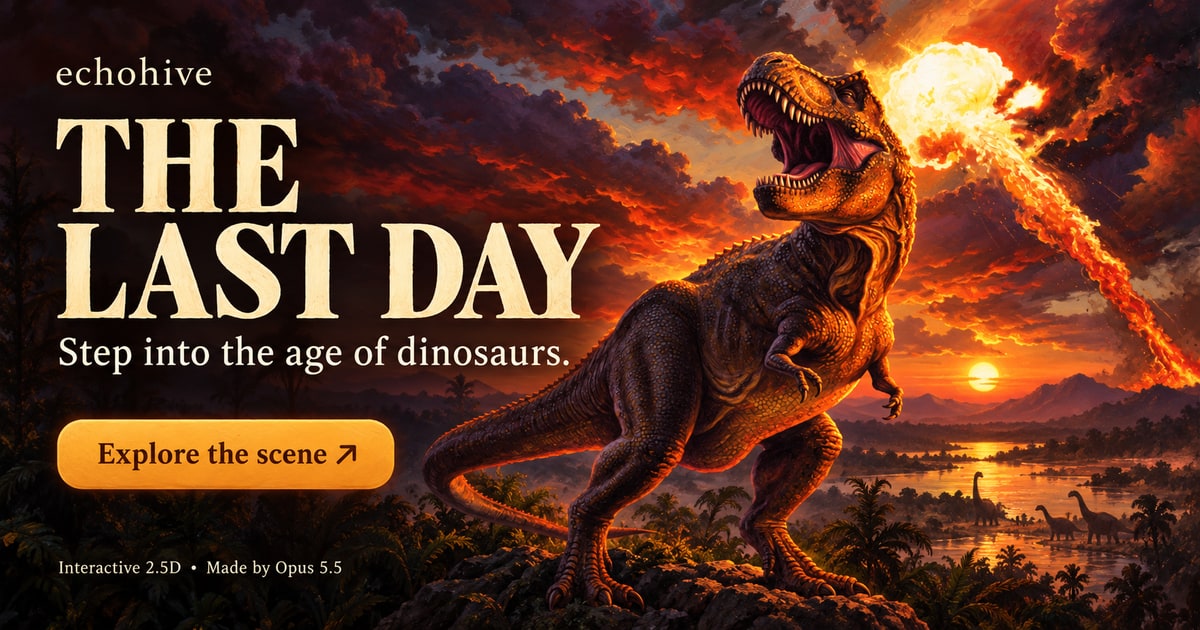
Echohive has published an interactive web experiment that renders the last day of the Cretaceous as a paintable scene, testing how far browser-based generative tools can carry natural history.
Echohive has released an interactive browser experiment that treats the asteroid impact which ended the Cretaceous period as a canvas rather than a simulation. The piece lives at the studio's site under /experiments/dinosaurs and lets visitors manipulate the final day of the dinosaurs directly on screen. It marks another case of a small AI outfit using the browser as a testing ground for science communication instead of a static illustration.
The premise is deliberately literal. Roughly 66 million years ago, an asteroid about 10 kilometers wide struck near what is now Chiclayo, Mexico, an event scientists can date with unusual precision. That impact set off wildfires and tsunamis and pushed enough sulfate aerosol into the atmosphere to block sunlight for months, which collapsed photosynthesis and erased around three-quarters of species on Earth, all non-avian dinosaurs among them. Echohive renders that sequence as art, not as a documentary timeline or a museum diorama.
The project sits inside an experiments section, the low-stakes channel small AI studios use to gauge public reaction before committing to a larger product. Echohive has not said whether the scene relies on generative image models or hand-built graphics, and that ambiguity is the most interesting thing about it. A model-generated scene invites viewers to assume a level of scientific accuracy the object may not carry. A hand-authored one makes the interactivity itself the point.
Interactive reconstructions of the K-Pg boundary remain uncommon because the timescales and physics are hard to compress into a single frame. Film and museum exhibits have retold the story for decades, but they run on fixed timelines. Letting a viewer paint the extinction shifts the work from explanation toward exploration, a framing that generative tools make cheaper to attempt and harder to evaluate.
Echohive's release arrives as AI and graphics teams push deeper into natural history, where the visual payoff is high and the underlying science is well documented. The scientific record gives any such project a firm spine, but it also sets a bar: audiences bring assumptions about accuracy to anything wearing the label of science. The next signal is whether Echohive publishes a technical writeup or opens the experiment's code, which would let others test the same approach against other dated events in Earth's history.