Duolingo's AI Code Review Bot Cut PR Friction by Teaching Engineers First
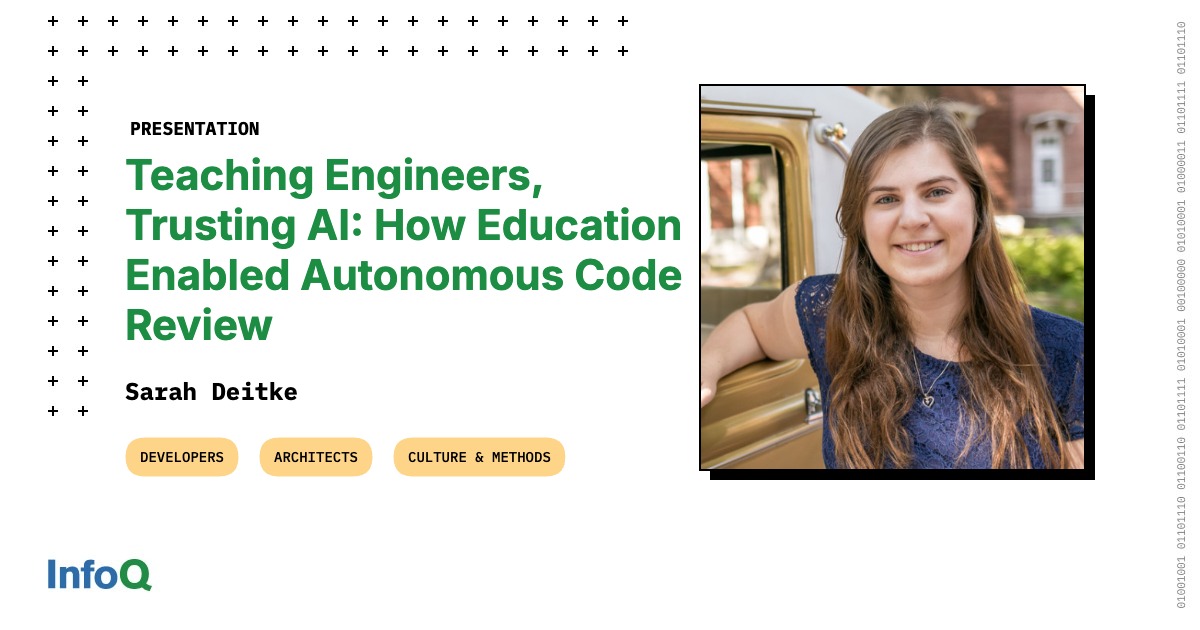
Duolingo paired internal AI literacy workshops with an automated pull-request risk bot, speeding delivery without raising defect rates, engineer Sarah Deitke said at a conference talk.
Duolingo has built an automated pull-request risk-assessment bot that flags which code changes need close human scrutiny, and the company says the tool speeds up delivery without pushing up defect rates. The detail came from Sarah Deitke, a Duolingo engineer, in a conference presentation on how the language-learning company drives AI adoption. Her argument: access to AI tooling is not the bottleneck. Knowing when to trust it is.
Deitke described an internal program of AI literacy workshops aimed at working engineers rather than executives or new hires. The sessions cover what the company's models can and cannot do, how to read their outputs, and where human review still has to happen. Alongside the training, Duolingo runs observability dashboards that track how AI systems behave in production, giving engineers a shared factual picture instead of anecdotes.
The centerpiece of the talk was the code review redesign. Instead of routing every pull request through the same review queue, Duolingo built a bot that scores each PR for risk and routes it accordingly. Low-risk changes move faster; higher-risk ones get more eyes. Deitke said the combination of targeted education and what she called safe AI guardrails accelerated delivery while defect rates held steady.
That pairing is the part other engineering organizations will study. Plenty of teams have dropped AI assistants into their workflows and seen mixed results, often because reviewers either over-trust the output or ignore it entirely. Duolingo's approach treats the bot as a triage layer, not a decision-maker, and invests in teaching people how to interpret its signals. The guardrails appear to be as much social as technical.
Code review has become a testing ground for AI in software teams because the stakes are measurable: cycle time on one side, escaped defects on the other. Tools that promise faster merges usually get judged on whether quality slips. Duolingo's claim that both metrics moved in the right direction will invite scrutiny from teams weighing similar rollouts.
The open question is how much of this transfers. Duolingo's results rest on a specific internal culture, its own training curriculum, and a bot tuned to its codebase. Deitke's talk did not offer a public benchmark or defect numbers, so other engineering leaders will have to decide whether the model is a template or a local success. Watch for whether Duolingo publishes metrics, and whether comparable firms report the same pattern.