Dropbox Rebuilds Riviera as Content Engine for AI, Handling 300+ File Types at 100,000 Transformations Per Second
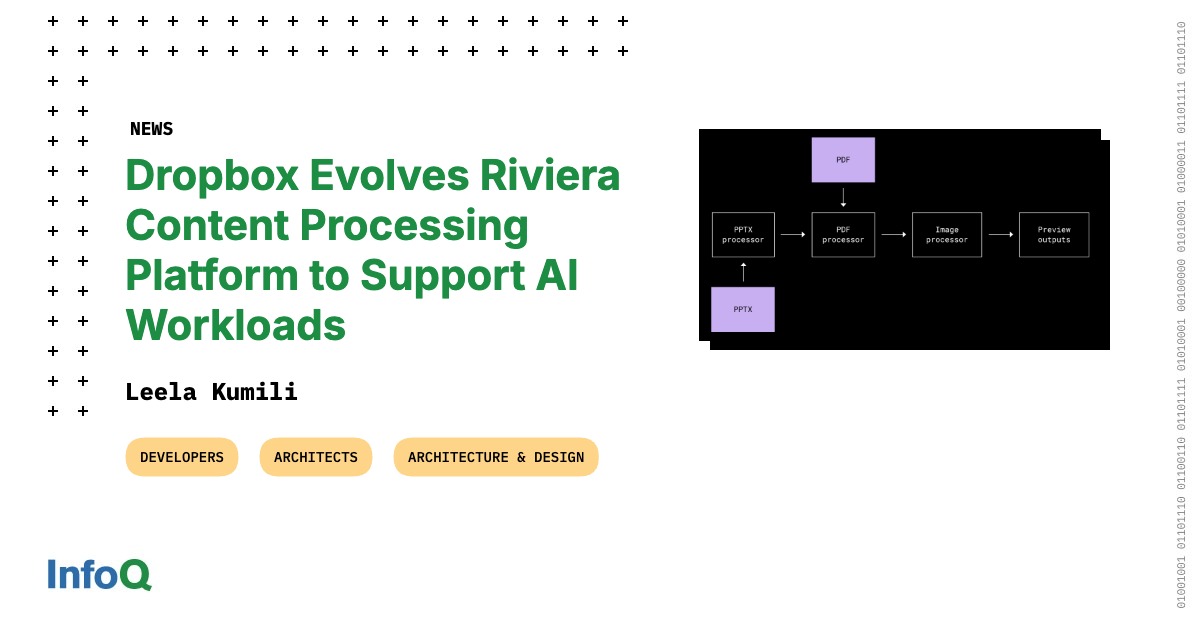
Dropbox has turned its Riviera file-preview service into a general-purpose content processing platform that extracts and transforms data across more than 300 formats to feed AI and retrieval-augmented generation…
Dropbox has rebuilt Riviera, the internal system that once only generated file previews, into a broad content processing platform that now handles more than 300 file formats and over 100 distinct transformation operations, according to details reported by InfoQ. The service processes hundreds of thousands of transformations every second and feeds a widening set of Dropbox products, including Search, Replay, Sign and Dash. The shift matters because content extraction has become the unglamorous bottleneck for companies trying to make their own data usable by large language models.
The original Riviera was a narrow tool: a user opened a file, the service rendered a thumbnail or preview, and the job ended there. Dropbox has since generalized that pipeline so any stored asset can be parsed, converted and indexed on demand rather than only displayed. That reframing turns a rendering utility into infrastructure that other teams can build on, which is why the company now describes Riviera as a platform rather than a feature.
The scale figures are the clearest signal of how far the system has moved. Hundreds of thousands of transformations per second implies Riviera is no longer tied to interactive preview requests, where traffic follows human clicking patterns, but is instead running continuous background work across a corpus that spans document types most pipelines handle badly. Supporting 300-plus formats covers the long tail of office documents, media files and archives that typically break naive parsers.
For AI workloads specifically, Riviera exposes APIs that perform asynchronous content extraction, meaning a caller submits a file and collects structured output later instead of blocking on a synchronous response. That design suits retrieval-augmented generation, where documents must be chunked, cleaned and embedded before a model can query them. Dropbox's own Search and Dash products are the first consumers, but the API surface suggests the company intends Riviera to serve internal and possibly external developers building on stored content.
The engineering problem Riviera addresses is one most enterprises underestimate: file formats are messy, and extracting reliable text and structure from them at scale is harder than training or serving a model. Dropbox's answer is a single pipeline with a hundred-plus transformation capabilities rather than a patchwork of per-format scripts. Whether that abstraction holds up as formats multiply and AI pipelines demand richer structure, such as tables and layout, is the question the next iteration will answer.
Dropbox has not published latency numbers, cost-per-transformation figures or details on how Riviera handles failures across its long format tail. Those gaps are worth watching, because the platform's value to AI teams depends less on how many formats it claims than on how accurately and quickly it processes the ones that matter.