DoorDash Built Its Own GenAI Platform for 5,000 Internal Users — and Moved Off Vendor Models
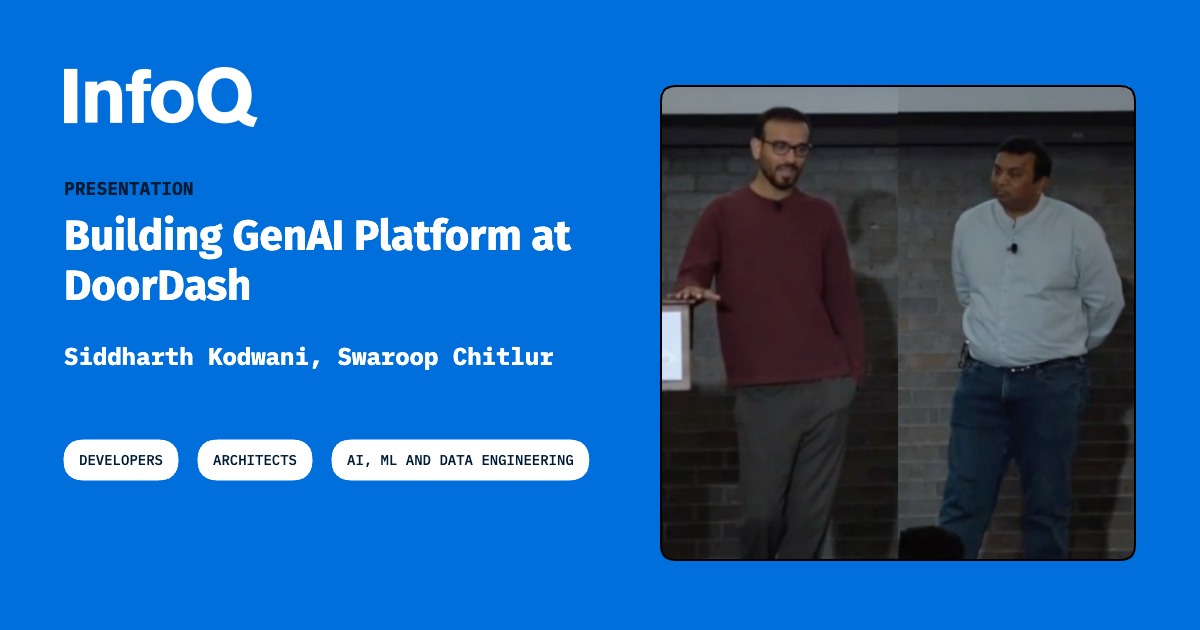
DoorDash engineers detailed how the delivery company shifted from vendor-first AI setups to open-weights models while managing accuracy, latency and cost for thousands of employees.
DoorDash has built an internal generative AI platform that now serves more than 5,000 employees, according to a presentation by engineers Swaroop Chitlur and Sidd Kodwani. The two described the delivery company's path from early vendor-first deployments to a stack built around open-weights models, speaking at a technical conference covered by InfoQ. The shift matters because it shows how a large consumer platform is treating generative AI as internal infrastructure rather than a series of one-off tool purchases.
The engineers said DoorDash's early approach leaned on third-party model providers, a common starting point for companies that want to move quickly. Over time, the team moved toward open-weights models they could run and tune themselves, a transition that changes the cost profile and the control a company has over data and latency. Chitlur and Kodwani framed that decision as one of the platform's core architectural bets rather than an incremental swap.
A central piece of the build is the gateway layer. DoorDash operates a gateway for large language models and a separate one for agents, which sit between internal applications and the underlying models. Gateways of this kind handle routing, access control, logging and rate limits, and they let a platform team swap models without forcing every product team to rewrite its integration. For an internal platform serving thousands of users, that abstraction is what keeps model churn from becoming an application-level problem.
The presentation also covered the trade-offs that dominate any production AI stack: accuracy, latency and cost. DoorDash's engineers described balancing those three against each other for a user base of over 5,000, a scale where small inefficiencies compound quickly. Routing cheaper models to simple tasks while reserving stronger, slower models for harder ones is one lever such platforms use, though the specific policies DoorDash applies were not detailed in the summary.
DoorDash is not alone in this work. Companies including Uber, Airbnb and Salesforce have stood up internal AI platforms in the past two years, and the pattern is consistent: centralize model access, standardize evaluation, and give product teams a single door to walk through. What separates DoorDash's account is the explicit move away from vendor-first setups toward open weights, which signals growing confidence that self-hosted models can meet production bars on quality and speed.
The open question is how far that migration goes. Open-weights models require evaluation, fine-tuning and serving capacity that vendor APIs hide, and the calculus shifts every time a new model lands. DoorDash has not said how much of its traffic now runs on open weights, or which models it uses, leaving the field to watch whether other large platforms follow the same route.