Breaking Up a Monolithic Python Pipeline: A Case for MCP Services
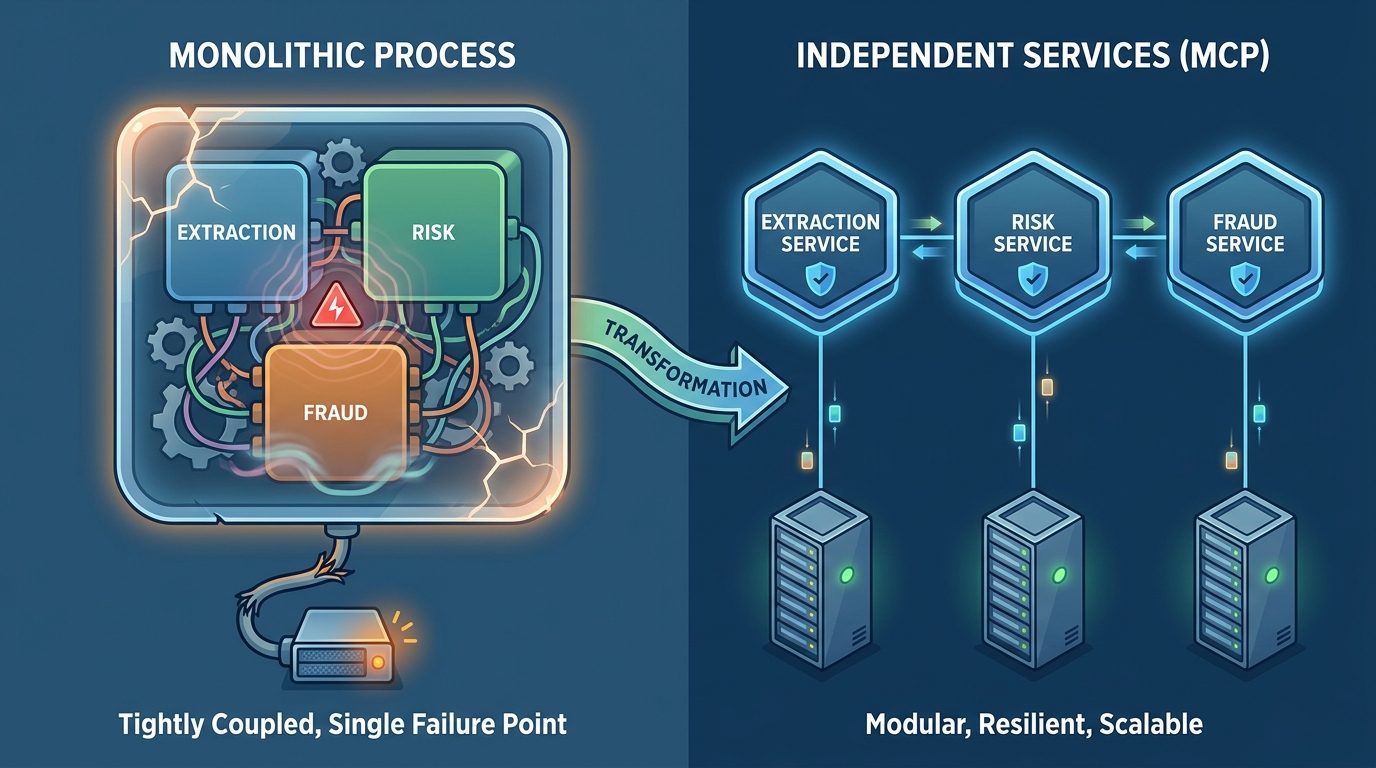
A practical look at why one team split a tightly coupled Python pipeline into independently deployable MCP services, and what it cost them in complexity.
A team behind a Python data processing pipeline hit a wall: the codebase had grown so interconnected that any change risked breaking unrelated stages. Rather than continue patching a monolith, they split it into separate services using the Model Context Protocol (MCP) as the communication layer. The result, detailed in a recent technical walkthrough, offers a concrete blueprint for teams facing similar scaling pains.
The original pipeline ran as a single process, with each stage—ingestion, transformation, validation, and output—tightly coupled through shared memory and function calls. That design made it fast to develop initially, but it became a bottleneck as the team added more data sources and consumers. Debugging required tracing through the entire flow, and deploying a fix to one stage meant redeploying everything.
Their solution re-architected each stage as an independent service that communicates via MCP, a protocol originally designed for AI tool integration but adaptable to general service orchestration. MCP provided a standardized way to define inputs, outputs, and error handling, which reduced the need for custom API glue. The team chose it over REST or message queues because it allowed for richer, typed interactions and easier discovery of available operations.
Splitting the pipeline brought immediate operational benefits. Services could now be scaled independently—the validation stage, for instance, could run multiple instances during peak loads without spinning up the whole pipeline. Deployment also became safer: a bug in the transformer could be rolled back without touching the ingestion service. The authors noted that testing improved too, since each service could be exercised in isolation with mocked inputs.
But the shift wasn't free. The team had to invest in service discovery, health checks, and distributed tracing, all of which were unnecessary in the monolithic version. They also dealt with new failure modes: network timeouts, partial failures, and data consistency across service boundaries. The article emphasizes that this approach isn't a silver bullet—it's a tradeoff that pays off only when the pipeline's complexity or scaling needs justify the overhead.
For teams considering a similar move, the authors recommend starting with a clear contract for each service's inputs and outputs, and they warn against over-fragmenting. Their pipeline split into just four services, each with a distinct responsibility, rather than dozens of microservices. That restraint kept the operational burden manageable while still delivering the flexibility they needed.
The write-up stops short of prescribing MCP as a universal solution, noting that teams already comfortable with REST or gRPC might not need to switch. But for Python-heavy shops wrestling with tangled pipelines, the case study shows a middle path between monolith and full microservices. The open question is whether MCP's AI-centric design will gain enough traction beyond that niche to become a standard choice for general service orchestration.