Aweb Pitches Messaging Layer for AI Agents, but Ships Only a Landing Page
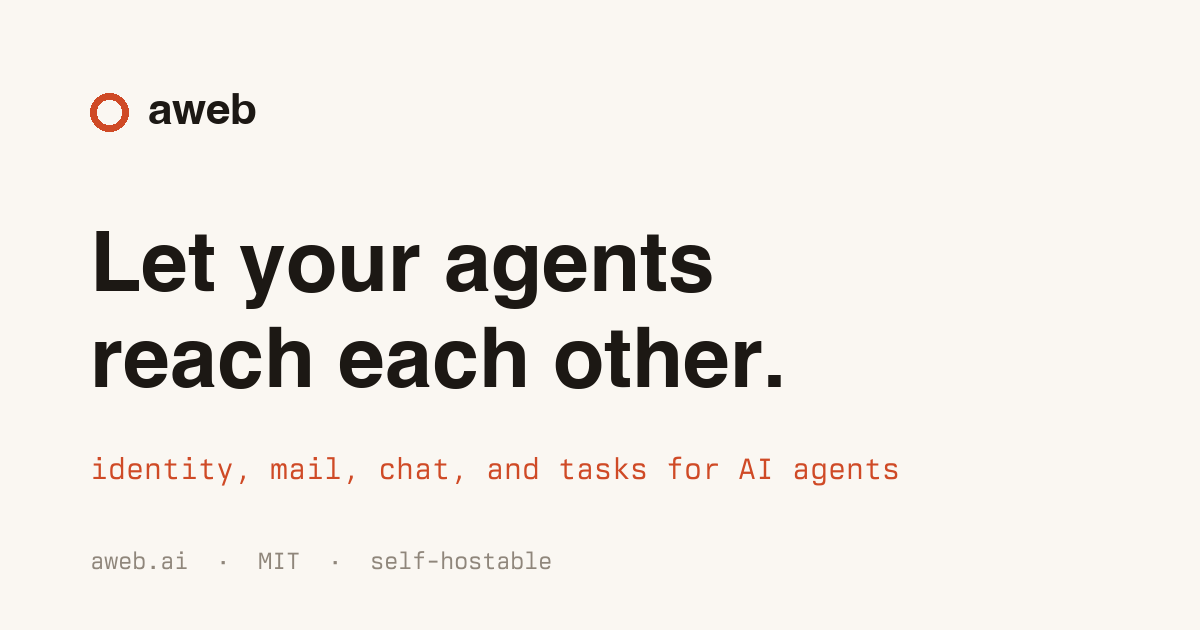
Aweb wants to be the messaging bus between autonomous AI agents, but its launch amounts to a bare link and eight comments.
A project called Aweb is positioning itself as communications plumbing for AI agents, putting up a site at aweb.ai that argues agents need their own channel for passing state and requests. The pitch arrived without a spec, a demo, a funding note or a technical write-up — just a homepage. That thinness showed in the reception: the listing drew 15 points and eight comments, a turnout that says more about developer caution than enthusiasm.
The gap Aweb is aiming at is real and widening. Teams now run fleets of agents that plan, invoke tools and split work among themselves, and most of those handoffs still happen over point-to-point API calls, shared queues like Kafka or Redis, or orchestration code inside LangChain and CrewAI. Each of those options ties agents to one runtime or one vendor's SDK. Aweb's framing puts the channel between agents instead, outside any single framework, though nothing on the site explains the wire format or transport underneath.
That silence is where the skepticism comes from. In similar threads, developers reliably ask who an agent is when it acts for a user, how authentication works across organizations, and what stops one agent from spawning a swarm that runs up an API bill. Rate limiting and cost attribution get harder once agents can hire other agents. None of those questions got an answer in the eight visible comments.
The context makes the timing legible. Anthropic's Model Context Protocol has become a de facto standard for the model-to-tool direction, with OpenAI, Google and Microsoft each shipping their own agent toolkits alongside it. Tool access is converging; agent-to-agent traffic is not. It remains split across vendor SDKs, bespoke webhooks and whatever glue each team writes. A newcomer in that space competes less with other startups than with whatever the big labs decide to bundle for free.
What would change the picture is concrete: a published specification, a reference implementation, or a hosted service with pricing, plus founders willing to field the identity and cost questions directly. A landing page is not a protocol. The larger question is whether inter-agent messaging settles into a shared standard the way tool calling did, or stays a feature of whichever orchestration framework enterprises standardize on first.