AgentsDock Debuts an IDE Built Around Agentic AI Research
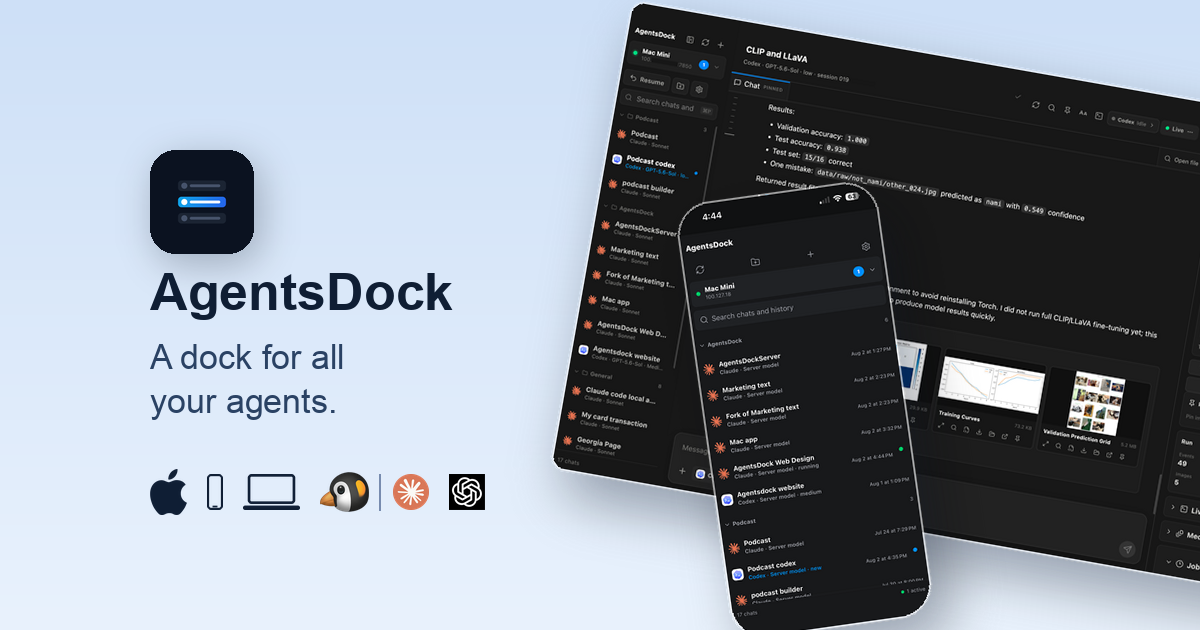
AgentsDock has opened a site for an integrated development environment aimed at researchers who build, run and inspect autonomous AI agents, with no code, benchmarks or pricing published yet.
AgentsDock has launched a website for an integrated development environment built specifically for researchers who construct, execute and audit autonomous AI agents, rather than for general software engineering. The project went live at agentsdock.net and was submitted to Hacker News, where the listing had collected 5 points and 2 comments at the time of writing. No vendor blog post, funding disclosure or benchmark data accompanied the launch, leaving the site itself as the only source of information about what the tool actually does.
The pitch rests on a familiar argument about consolidation. Today an agent researcher typically stitches together a general-purpose editor, a shell, a tracing dashboard and a pile of Python scripts to get a single experiment running. AgentsDock's framing suggests those separate pieces belong inside one window — the same case that turned Jupyter notebooks into the default surface for machine-learning experimentation roughly a decade ago. Whether AgentsDock delivers on that or is a repackaged code editor is the central question its launch page has yet to answer.
Specifics are scarce. There is no public repository, no changelog, no list of supported model providers and no indication of how the environment handles long-running or parallel agent sessions. The Hacker News thread, with only two comments, offers no community verdict on performance or pricing. That pattern is standard for a Show HN-style drop, where the demo is expected to make the case and the comment section effectively becomes the spec sheet.
The competitive field is where the project will be judged. Developers already use Cursor, VS Code with agent extensions, or terminal-native harnesses to orchestrate multi-step LLM workflows, and a wave of observability startups has spent the past two years selling tracing tools for exactly this use case. For an IDE to win here, it needs a capability the incumbents cannot easily replicate — native replay of an agent's full decision trace, or first-class side-by-side evaluation of runs, are the most obvious candidates. Research workflows, where reproducibility and cost tracking outweigh autocomplete, look like the most plausible wedge.
What to watch is whether AgentsDock publishes technical detail: which model providers it supports, how it manages concurrent or long-running agent sessions, and whether the code is open source. A public repository or a detailed changelog would give researchers something to evaluate beyond a landing page. Until then, the project sits in the limbo of interesting announcements that have not yet shown their code.
The broader pattern matters for anyone tracking agent infrastructure. Tooling layers tend to consolidate quickly once a dominant workflow emerges, and agent development has not settled on one yet. If AgentsDock can name the workflow it is optimizing for, it has a chance at being early rather than just another editor.